











You open a document that actually matters. A few pings land in the first fifteen minutes, each one small enough to answer quickly, but disruptive enough to break your focus. By the time the noise settles, the long stretch of concentration the work required is gone. That gap between what your job rewards and what your day allows is exactly why deep work matters.
Deep work is distraction-free concentration on cognitively demanding work that creates new value and builds skill. Cal Newport, a computer science professor at Georgetown, coined the term in Deep Work: Rules for Focused Success in a Distracted World. In practice, deep work is the kind of focused effort that helps you solve hard problems and make meaningful progress on tasks that cannot be rushed between meetings.
This guide explains deep work and shows how to integrate deep work into a modern schedule. It covers the core definition, the science of sustained focus, Newport’s framework, and a practical system for protecting deep work on your calendar.
What is deep work?
In his book, Cal Newport defines deep work as “professional activities performed in a state of distraction-free concentration that push your cognitive capabilities to their limit. These efforts create new value, improve your skill, and are hard to replicate.”
What makes deep work distinct is the depth of concentration it requires and the quality of output it makes possible. It usually involves hard problems, critical thinking, and enough uninterrupted time for deep thinking to compound.
Newport’s Deep Work Hypothesis is simple: deep work is becoming more valuable as it becomes more rare. That idea explains why protected focus matters so much in modern work. The ability to concentrate deeply has become both a performance advantage and a career advantage.
Research on attention helps explain why deep work is so hard to protect. In Attention Span, Gloria Mark, Chancellor’s Professor of Informatics at UC Irvine, reports that the average attention span on any screen is now 47 seconds, with a median of 40 seconds.
Interruptions carry a cost after the moment itself. Mark and colleagues found that returning to the same level of focus can take about 23 minutes and 15 seconds after an interruption. In other words, fragmented work does not just break concentration for a moment, it weakens the quality of the time that follows.
That pattern shows up in workplace data as well. Reclaim’s research suggests that workers get less deep work than they need, switch attention frequently, and struggle to protect focused time across the week.
Need help sorting deep work from shallow work? Our deep work vs. shallow work guide compares email, status updates, and routine coordination with focused work so you can draw the line for your own role.
Why does deep work matter (& why is it disappearing)?
Deep work matters because a lot of the most valuable work people do still depends on sustained concentration. Strategy, research, writing, systems design, and complex problem-solving all get better when there is enough uninterrupted time to think clearly and work past the obvious first pass.
The benefits of deep work
That kind of focus has become harder to protect. Most workplaces run on responsiveness. Calendars fill quickly. Chat stays open all day. Small requests keep arriving, and each one feels manageable on its own. Together, they chip away at the long stretches of time deep work depends on.
Workers average 2.9 deep work sessions per week, yet say they need 4.2 to feel productive. That adds up to a 31.3% deep work deficit.
For most people, multitasking is really just rapid switching between tasks. Across studies, that switching reduces productivity by 20 to 40%. Sophie Leroy’s research on attention residue adds another layer: when you switch from one unfinished task to another, part of your attention stays behind. That means the next task starts with less than your full focus.
Reclaim’s Task Management Trends Report, based on responses from 2,000+ professionals, shows how task work, interruptions, and reprioritization squeeze focused work across a typical week.
The encouraging part is that the picture changes when focused work is treated as real work on the calendar. Reclaim users who adopt structured scheduling protect more of the week for productive work, recover additional hours, and avoid some of the meeting creep that usually takes over open time. Once focus becomes visible, it gets easier to defend.
For a closer look at the behavioral cost of constant switching, see our context switching guide.

What are Cal Newport's four rules of deep work?
Newport’s four rules are: (1) work deeply by building routines and rituals, (2) embrace boredom to train your attention, (3) quit social media or apply a strict cost-benefit test, and (4) drain the shallows by quantifying and capping low-value work. Together, those rules turn deep work from a good intention into a repeatable deep work practice.
Rule 1: Work deeply
Deep work is easier to sustain when it is built into your routine. A predictable deep work routine beats heroic sprints. Newport’s answer is not to rely on motivation in the moment. It is to create rituals, boundaries, and schedules that make focused work easier to start and easier to protect.
He outlines four scheduling philosophies:
If you work in a typical office environment, the rhythmic approach is usually the most practical. Blocking the same time each day (ideally at exactly the same time on the days you defend it) gives deep work a predictable place in your week and makes it easier for other people to work around it.
A short pre-session ritual helps too. Decide where you will work, when the block starts, how long it will last, and what needs to be ready before you begin. That small amount of structure removes friction at the start of the session and signals that you are entering a deep work mode, so it becomes easier to get into focused work quickly.
For a closer look at how deep work differs from shallow work, see our comparison guide.
Rule 2: Embrace boredom
If every quiet moment gets filled with email, feeds, or quick checks, your brain gets used to constant stimulation. After a while, sustained focus starts to feel unusually hard. Boredom tolerance matters because deep work asks you to stay with a difficult task long enough for concentration to settle in.
One of Newport’s exercises is productive meditation. Pick a professional problem and think it through while walking, stretching, or doing another low-demand physical activity. When your mind drifts, bring it back to the problem. Over time, that repeated return helps strengthen your ability to direct attention on purpose.
Start small if you need to. Five minutes is enough to begin. What matters most is consistency. Each time you resist the urge to reach for novelty, you build more capacity for deep work.
Rule 3: Quit social media (or at least be intentional)
Newport’s craftsman’s approach to tools is simple: use a platform only when its value clearly outweighs the cost to your attention and time. The point is not to delete everything. The point is to stop treating every tool as automatically necessary.
A short trial can help. Step away from optional platforms for 30 days, then look at what actually changed. Which tools supported meaningful work or relationships? Which ones mainly filled small gaps in attention? Keep the tools that serve a clear purpose, and use them with more intention.
Rule 4: Drain the shallows
Shallow work tends to spread unless it has boundaries. Newport’s advice is to make it visible. Schedule your day with more precision, estimate how much shallow work your week can hold, and notice which shallow tasks quietly consume the margins between meetings.
His recent-college-graduate test is a useful filter. If a task could be handed off after a short ramp-up, it may not deserve your best focus hours. That does not make the task unimportant. It simply helps clarify which work needs your full attention and which work belongs in a different part of the day.
For a closer look at how to separate deep work from shallow work, see our deep work vs shallow work guide. It includes side-by-side examples you can use to audit your own calendar.
How do you actually do deep work? A practical system
A practical deep work system has four parts: know how many hours of focused work you can realistically sustain, use a repeatable session structure, block deep work on your calendar before other commitments take over, and protect those blocks once they are there. The goal is to perform deep work reliably, not only on quiet days.
Determine your deep work capacity
Deep work is just like strength training. Capacity builds over time, and most people do better when they increase it gradually. Be honest about how many hours you can repeat without draining the rest of your week.
That range lines up with research on deliberate practice. K. Anders Ericsson found that expert performers rarely sustain more than about 4 hours of intense practice in a day. Newport makes a similar point in interviews about Deep Work: shorter blocks can still help, though deeper benefits usually show up once a session runs past the first hour.
Structure your deep work sessions
A repeatable session structure makes it easier to start and easier to stay with the work.
A good deep work session usually has a short ramp-up, a longer stretch of real concentration, and a clear stopping point before attention starts to fade. For many people, 60 to 90 minutes is a strong working range.
The important part is not chasing a perfect interval. It is giving yourself enough uninterrupted time to settle into the task. If 90 minutes feels too long right now, shorter focus sessions can still help build the habit.
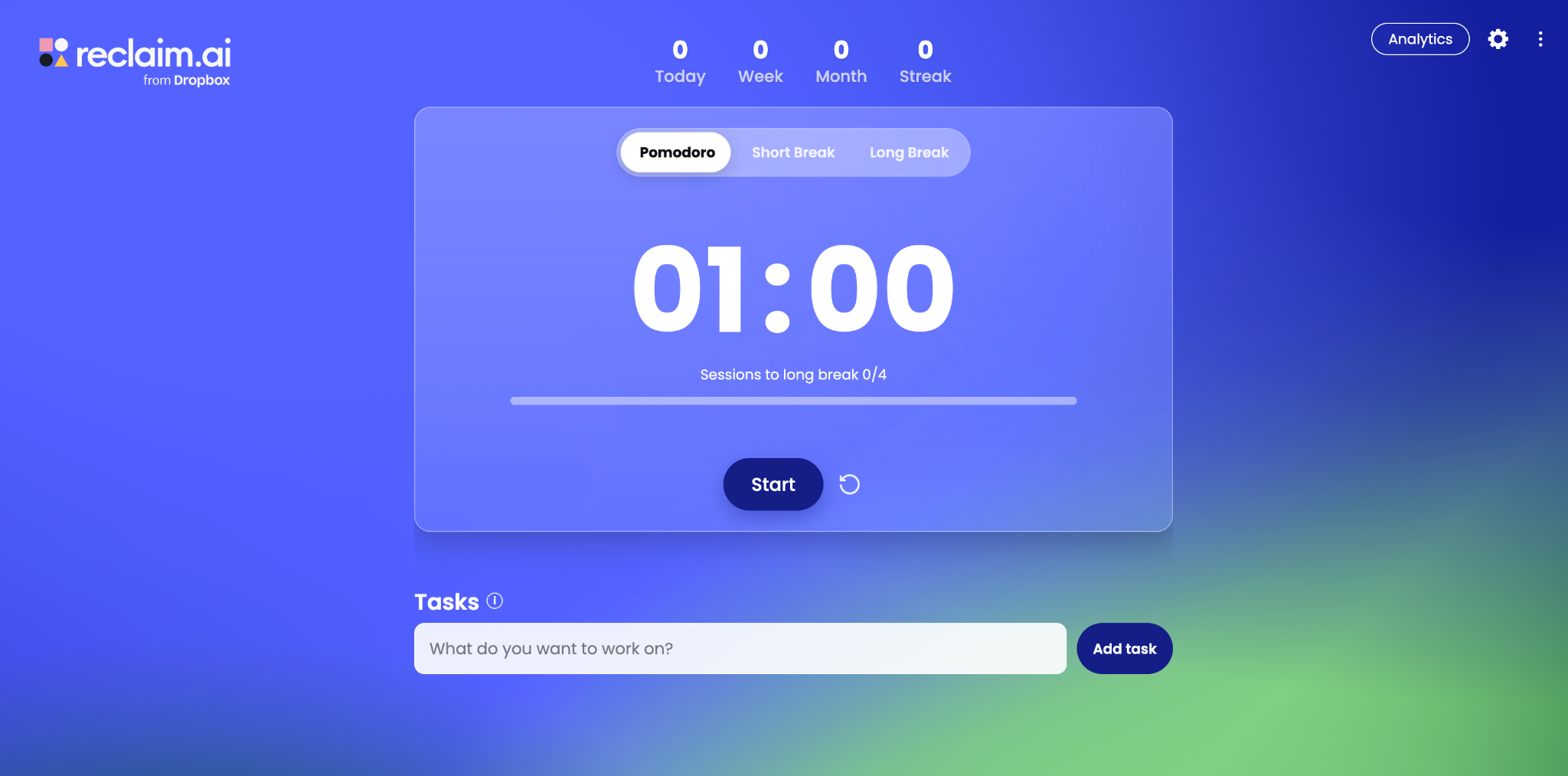
The Pomodoro Technique can be a useful stepping stone here. It gives you a simple way to practice focused work in smaller blocks until you are ready for longer sessions. Our Pomodoro timer can help you run those reps.
Open the full Pomodoro Timer →
Schedule deep work on your calendar
Deep work is easier to protect when it has a visible place in the week. Prioritize deep work on the calendar the way you would a client deadline: put it on before meetings and reactive work fill the open space. For most office-based roles, the most practical option is a consistent block at the same time on most days.
Treat that block like real work. Name it clearly. Put it on your shared calendar. Let people see that the time is already spoken for.
Protect deep work from interruptions
Once a block is scheduled, the next step is protecting it. Turn on Do Not Disturb, mute nonessential notifications, and update Slack or Teams so people know you are heads-down and when you plan to respond.
It also helps to batch shallow work into specific windows. Email, chat, and routine triage can expand quickly when they stay open all day. Giving them a defined place makes it easier to keep your focus blocks intact.
At the team level, norms matter too. No-meeting days, quieter mornings, and async-first updates all make deep work easier to sustain. When focus is treated as part of how the team works, protecting it gets much easier.
What does neuroscience say about deep work?
Focused effort changes the brain over time. It strengthens the neural pathways involved in demanding work and supports the kind of learning that comes from sustained practice. When you focus deeply for a full session, you are asking those circuits to fire together long enough to adapt. That is one reason deep work can feel effortful at first, then more fluid as a skill develops.
How focus builds your brain
One of the main ideas here is myelination. Daniel Coyle’s The Talent Code explains myelin as the fatty sheath that wraps neural pathways during demanding practice. As those pathways become more insulated, signals move faster and more reliably. That is why deep, repeated practice can make complex thinking feel smoother over time.
Deep work supports that kind of practice because it combines sustained attention with meaningful challenge. You are staying with one difficult task long enough for skill and judgment to build through repetition—the same quality-over-quantity idea that deliberate practice research ties to expertise.
Another part of the picture is BDNF, or brain-derived neurotrophic factor, which helps support learning and plasticity. Effortful cognitive work is associated with stronger BDNF responses than easier repetition. In simple terms, the strain you feel during hard thinking is often part of how learning happens.
That helps explain why a focused 60 to 90 minute session can do more for skill growth than a longer block filled with interruptions. The quality of attention matters. Time alone does not do the full job.
Why multitasking sabotages depth
In knowledge work, multitasking is usually rapid switching between tasks. That switching comes with a measurable cost. Productivity drops, attention fragments, and unfinished work keeps pulling at the mind even after you move on.
Sophie Leroy’s research on attention residue helps explain the effect. When you leave one task unfinished and turn to another, part of your attention stays with the first task. The second task starts with less of your focus available. Over the course of a day, that split attention adds up.
For most kinds of cognitively demanding work, depth supports better performance than constant switching. The brain handles complex work better when it can stay with one challenge long enough to build momentum.
The connection between deep work and flow
Deep work creates the conditions that make flow more likely. Flow, a concept developed by Mihaly Csikszentmihalyi, is the state of deep absorption people sometimes reach when challenge, skill, and concentration align.
It does not happen automatically. The work needs a clear goal. You need feedback that helps you tell whether you are making progress. The task has to be difficult enough to stretch your ability, while still feeling manageable. Then concentration has to hold long enough for those conditions to lock in.
That is part of what makes deep work valuable. It improves output, and it can also change how work feels while you are doing it. When attention settles, difficult work often becomes more engaging and more meaningful.
How can teams and managers protect deep work?
Deep work is easier to sustain when teams support it together. Managers play a big part in that. Calendar norms, communication habits, and meeting culture all shape how much focused work survives the week and those habits rarely stay confined to the office. What protects attention at work often carries into professional and personal life, where boundaries matter just as much. When leaders protect focus in visible ways, the team has a better chance of doing the same.
Managers feel the pressure too. Broader benchmarks often place engineers and designers around 40 to 44% of their time in deep focus, while managers tend to land closer to 27%. Managers say they want 9.4 more protected hours per week for each individual contributor, yet rate their own ability to shield teams from interruptions at 5.3 out of 10.
A few team habits make a real difference. Shared no-meeting days create longer stretches for focused work. Clear focus-time expectations make it easier for people to protect time without feeling unavailable. Async updates reduce the pressure to respond in the moment. Visible focus blocks on shared calendars help teams plan around real work instead of treating concentration as leftover time.
It also helps to measure focus in a useful way. Teams can treat protected time as a health signal for how work gets done across the week. Once focus is visible, it becomes easier to protect and easier to discuss.