Launch a Slack Notifications Initiative to cut interruptions by 60%
Activate a company-wide Slack Notification Initiative and automatically sync Slack status with real calendar context — so interruptions drop, focus time is protected, and teams know exactly when to collaborate.
"Reclaim gives my team the ability to structure their day in an automated fashion. Now, they can put tasks into Reclaim and it handles the scheduling, taking care of deadlines and remaining work hours. It takes the work out of organizing the day, which helps those brilliant minds to focus on the right task at the right time."
Slack interruptions rarely feel dramatic — but they compound. A quick ping during focus time can derail 15–20 minutes of momentum. Multiply that across a week, and it meaningfully fragments the workday.
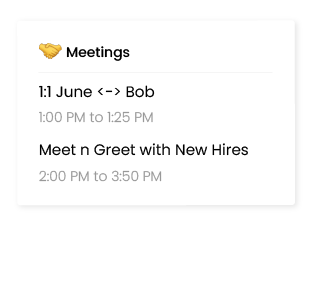
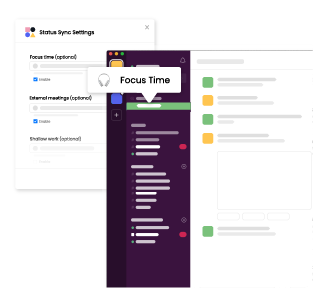
This initiative aligns Slack status with real calendar context — meetings, focus time, travel, and transitions — so employees don’t have to constantly signal availability or defend their time. Their status reflects what they’re actually doing, automatically.
The impact is subtle but powerful:
Fewer interruptions during deep work
Fewer mid-meeting notifications
Less pressure to respond instantly
More confidence that protected time will stay protected
Employees remain reachable. Communication doesn’t slow down. But messages arrive with better timing — allowing people to stay responsive without sacrificing concentration or energy.
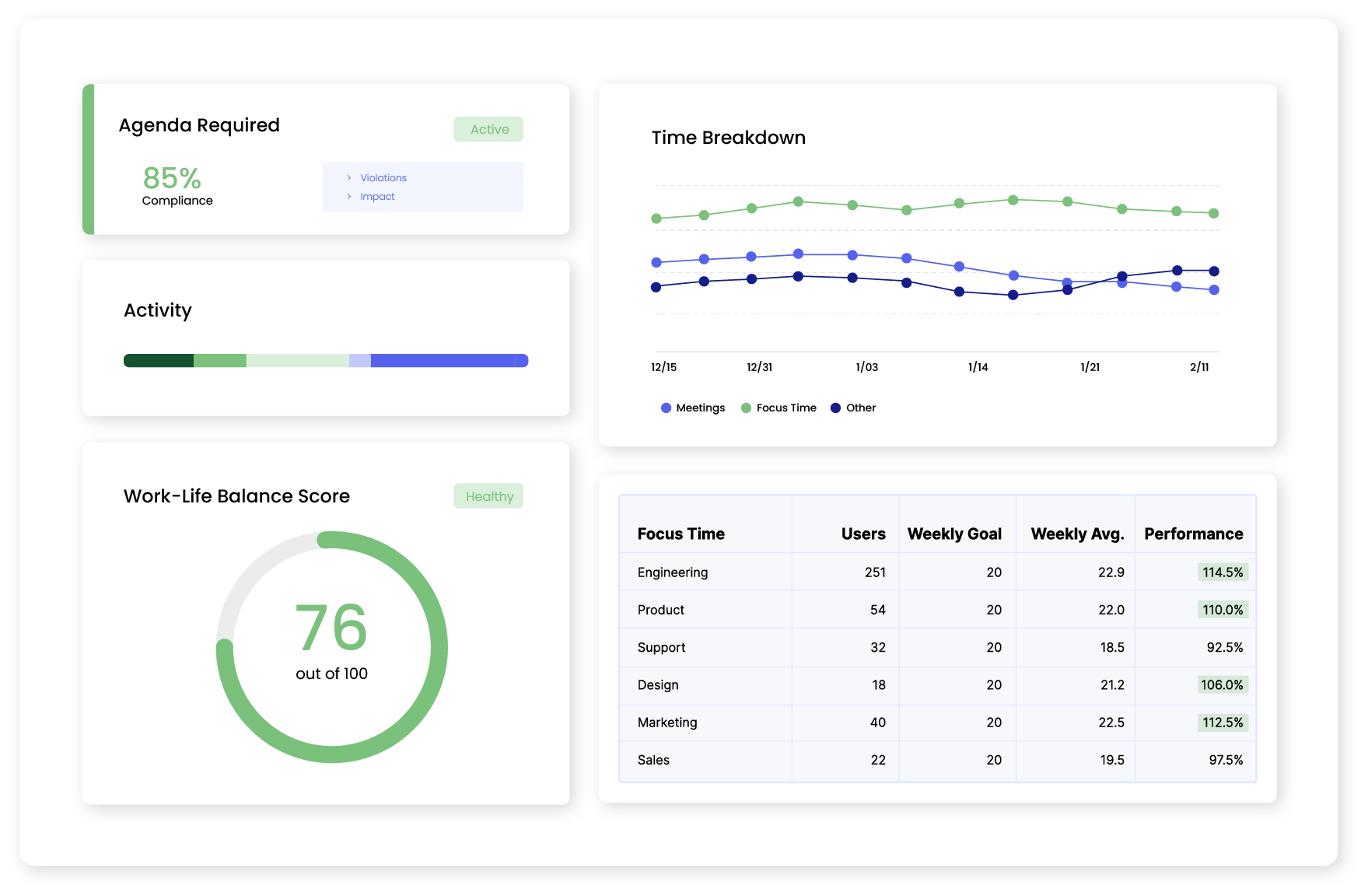
By aligning Slack status with real-time availability, you can analyze changes in interruption timing, focus protection, and responsiveness patterns over time. Leaders gain visibility into whether meetings, focus blocks, and availability windows are being respected in practice — not just scheduled in theory.
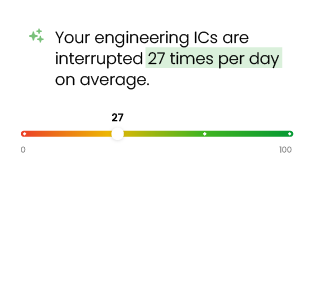
You can benchmark interruption trends by team or role, set realistic improvement targets, and measure progress against those goals. This turns notification reduction into a measurable, manageable part of your operating model.
Slack usage patterns vary by role and function. Engineers may need long, uninterrupted focus blocks. Sales teams may prioritize rapid responsiveness. Managers sit somewhere in between.
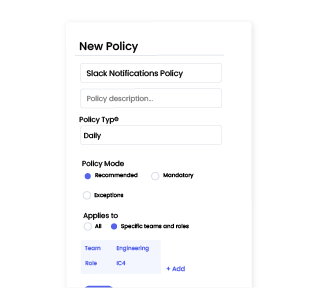
Initiative goals can be applied by role, team, or department using directory attributes — including SCIM-managed fields such as department, title, team, or level. This allows you to define differentiated availability standards without managing individuals manually.
As employees join, change roles, or move between teams, policies automatically adjust based on directory data. That ensures consistency where needed, flexibility where appropriate, and no administrative burden as the organization evolves.
Instead of one rigid rule, you create structured availability standards tailored to how each function actually works.
Enterprise calendars are dynamic. Meetings move. Focus blocks get rescheduled. Travel is added. Cancellations happen.
Availability signals update in real time as those changes occur. If a meeting is shortened, moved, or replaced, Slack reflects that shift immediately. There’s no stale “In a meeting” status lingering after plans change.
This is critical in fast-moving environments where trust in status signals determines whether behavior changes. If availability becomes unreliable, teams revert to interrupting by default. By keeping signals accurate throughout the day, the initiative preserves credibility — and credibility drives adoption.
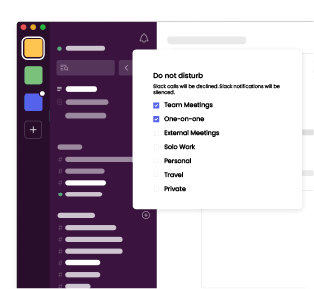
Slack’s native status requires manual updates, which quickly become outdated. Do Not Disturb silences notifications but doesn’t explain availability or work context.
This initiative continuously reflects calendar-based availability automatically and at scale. It doesn’t just mute interruptions — it improves their timing by making work context visible.
Instead of simply muting notifications, teams gain clear visibility into real work context — whether someone is:
In a meeting
In protected focus time
Traveling
Between commitments
That clarity makes it easier to time communication appropriately.
Leaders don’t need to monitor Slack messages — they need confidence that structured work time is actually being respected.
When Slack status reflects meetings and protected focus time in real time, leaders can see whether interruption-reduction standards are holding up in daily operations. If focus blocks are consistently interrupted or meetings override protected time, that becomes visible in the data.
Combined with benchmark targets and interruption analytics, this creates a practical improvement cycle:
Define availability standards
Apply policies by role or team
Measure interruption and timing patterns
Adjust targets based on results
This turns availability into something leaders can manage deliberately — reinforcing focus time and meeting health initiatives without introducing surveillance or micromanagement.
Most organizations begin with a clear operational objective — such as reducing interruption-driven productivity loss or reinforcing existing focus time and meeting health standards.
From there, availability policies are enabled at the team or department level. Because status updates automatically reflect real calendar context, employees don’t need to change how they work, reschedule meetings, or learn a new system.
There are:
No workflow overhauls
No new communication rules
No retraining required
Slack simply becomes a more accurate signal of availability.
Teams continue operating as they normally would — but with fewer mistimed interruptions and clearer communication norms. Once results are validated, the same structure can scale across the organization in a predictable, low-friction way.
Yes. Many organizations begin with a focused pilot of 20–100 employees to establish baseline interruption metrics, test notification-reduction targets, and measure impact within a defined team or function before expanding.
We work with you to configure availability standards, benchmark current interruption patterns, and evaluate measurable improvements under real operating conditions. Once validated, the same framework can scale predictably across the organization using defined policies and rollout milestones.
Book a demo to explore pilot options for your company.
Ready to explore your own Slack Notification Initiative?