









Professionals are not getting the focus time they need to do their best work.
New Reclaim.ai survey data from Google Cloud Next 2026 shows a consistent pattern across modern work: employees aren’t getting enough time for deep work, meetings consume nearly two full workdays per week, and the strongest appetite for AI scheduling automation is not for replacing human judgment, but for protecting focus time, reducing calendar fragmentation, and handling routine scheduling tradeoffs.
Across the survey, the signal is clear: people want intelligent systems that defend time, reduce meeting chaos, and keep humans in control of important decisions.
Report overview:
- 43.5% of employees average 2 or fewer deep work sessions/week
- Employees average 15.8 hours/week in meetings
- 69.9% spend 10+ hours/week in meetings
- 67.8% want AI to protect focus time for them before it’s booked
- 77.3% prefer human-in-the-loop scheduling automation
Together, these findings point to a structural productivity gap: employees know they need sustained focus time to do their best work, but their calendars are still dominated by meetings, fragmented schedules, and manual coordination.
Employees average only 3.7 deep work sessions per week
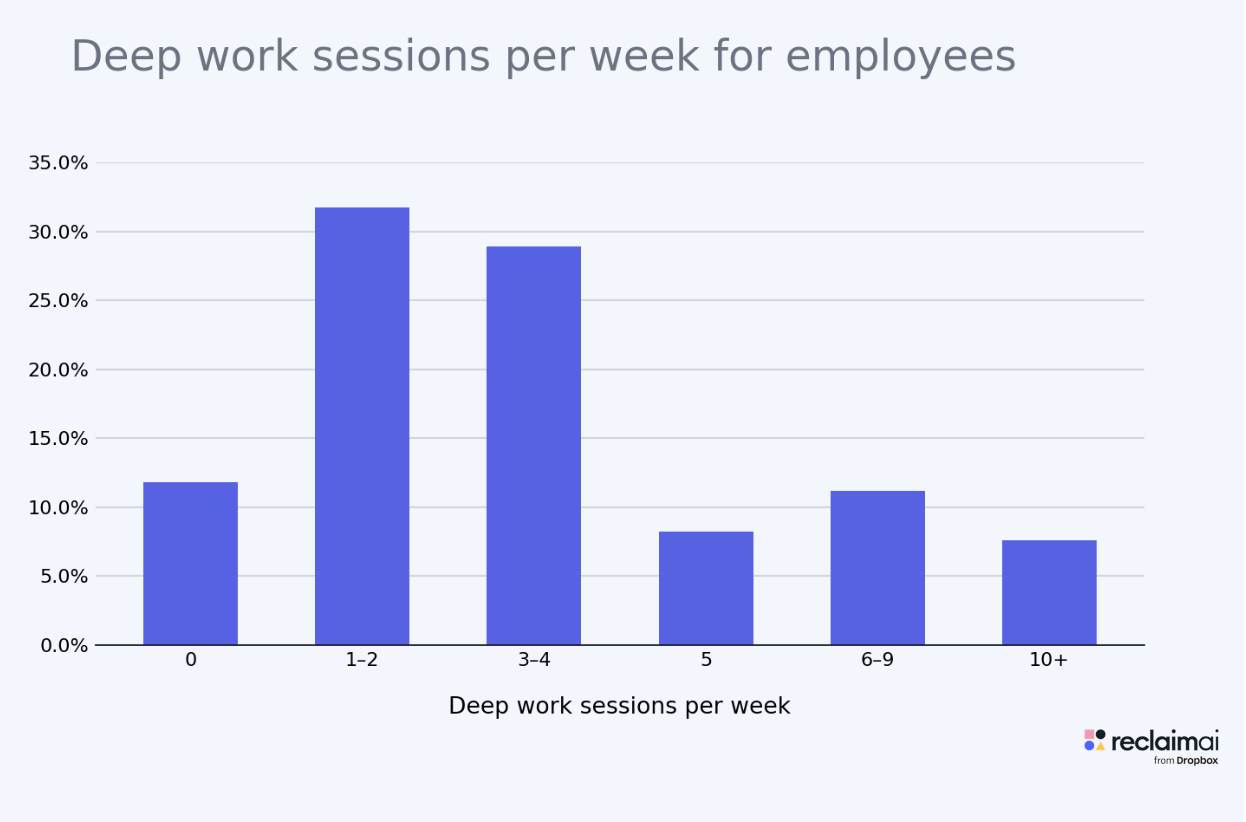
Deep work is becoming one of the clearest indicators of whether modern work is actually productive. In our survey, respondents reported averaging just 3.7 deep work sessions per week, where a deep work session is defined as 2+ hours of focused work.
Most employees are not getting daily deep work:
- 11.8% get 0 sessions/week
- 61.2% get 1–4 sessions/week
- 8.2% get 5 sessions/week
- 11.2% get 6–9 sessions/week
- 7.6% get 10 or more sessions/week
The biggest signal is not the average, but where the distribution sits. 43.5% of respondents get 2 or fewer deep work sessions per week, meaning a large share of professionals are not even getting focused work blocks every other workday.
Only 8.2% average exactly one deep work session per workday, and even when including those above that level, just 27% reach or exceed a daily focus cadence. That means nearly three-quarters of respondents fall short of one deep work session per workday.
This suggests deep work is still treated as leftover time. It is something people fit around meetings, messages, and shifting priorities, rather than something the workweek is designed to support.
Employees need 5.1 deep work sessions per week to feel productive
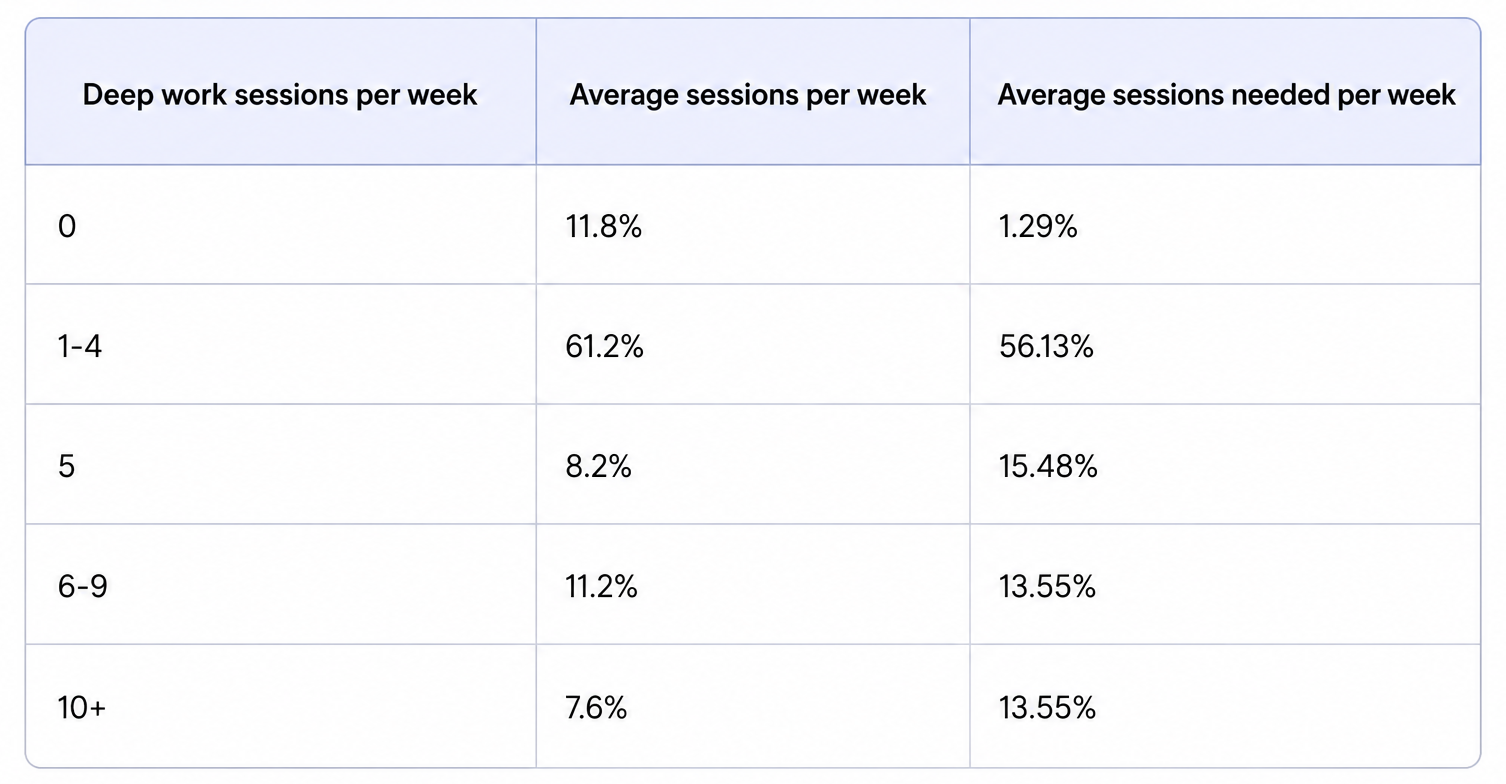
When asked how many deep work sessions they need per week to feel productive, respondents reported an average of 5.1 sessions/week.
Employees report needing more deep work sessions per week than they currently get:
- 1.29% need 0 deep work sessions/week
- 56.13% need 1–4 sessions/week
- 15.48% need 5 sessions/week (1 per workday)
- 13.55% need 6–9 sessions/week
- 13.55% need 10 or more sessions/week
While most respondents report needing 1–4 sessions per week, a significant share require much higher levels of focus time, which raises the overall average to 5.1 sessions.
The largest group still falls in the lower range, reinforcing that most professionals do not need extreme amounts of uninterrupted time. What they need is consistent access to it.
This is an important distinction. The data does not suggest that people want empty calendars. It suggests they want a more balanced calendar, where collaboration and focus can both fit into the week.
Employees face a 27.4% deep work shortfall
The clearest finding comes from comparing actual vs. needed deep work:
- Actual deep work: 3.7 sessions/week
- Needed deep work: 5.1 sessions/week
- Gap: 1.0 fewer sessions/week
- Shortfall: 27.4%
That gap may sound small at first. It amounts to roughly 1.4 missing deep work sessions per week. Across a team, department, or company, it compounds quickly. For every 100 employees, that translates to about 140 missing sessions per week, or more than 280 hours of lost sustained focus capacity.
The gap becomes even clearer when comparing high-focus needs against reality:
- 42.6% need 5+ deep work sessions/week
- Only 27.1% actually get 5+ deep work sessions/week
- That is a 15.5-point gap between daily-focus demand and daily-focus reality
This is the core story: employees are not asking for more time because they are bad at time management. They are asking because the structure of the workweek is not giving them the focus time their work requires.
Meetings consume nearly 2 full workdays per week
Meetings remain one of the biggest constraints on focus time. Respondents spend an average of 15.8 hours per week in meetings, equal to nearly 2 full 8-hour workdays.
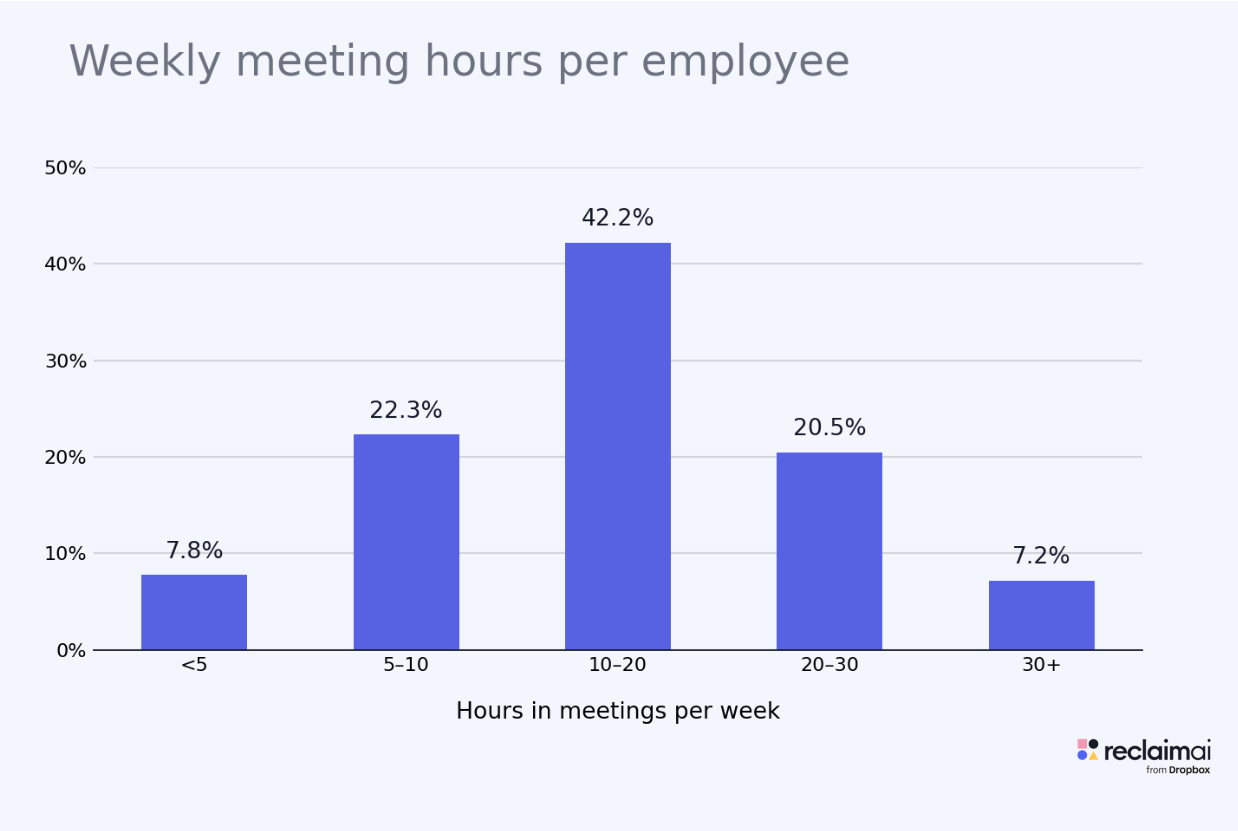
Across respondents, weekly meeting time breaks down as follows:
- 7.8% spend <5 hours/week
- 22.3% spend 5–10 hours/week
- 42.2% spend 10–20 hours/week
- 20.5% spend 20–30 hours/week
- 7.2% spend 30+ hours/week
Across the dataset:
- 69.9% spend 10+ hours/week in meetings
- 27.7% spend 20+ hours/week
The most common meeting-load range is 10–20 hours per week, selected by 42.2% of respondents.
This suggests that for many employees, meetings are not occasional coordination moments. They are a major operating layer of the workweek. For more than 1 in 4 respondents, meetings take up at least half of a standard 40-hour workweek.
That matters because deep work requires long, uninterrupted blocks. Even when meeting hours are not excessive in total, poorly distributed meetings can fragment the day into short gaps that are too small for meaningful focus.
The top AI automation request: protect focus time
When asked which AI automations would be most valuable, respondents prioritized practical improvements to how time is scheduled and managed.
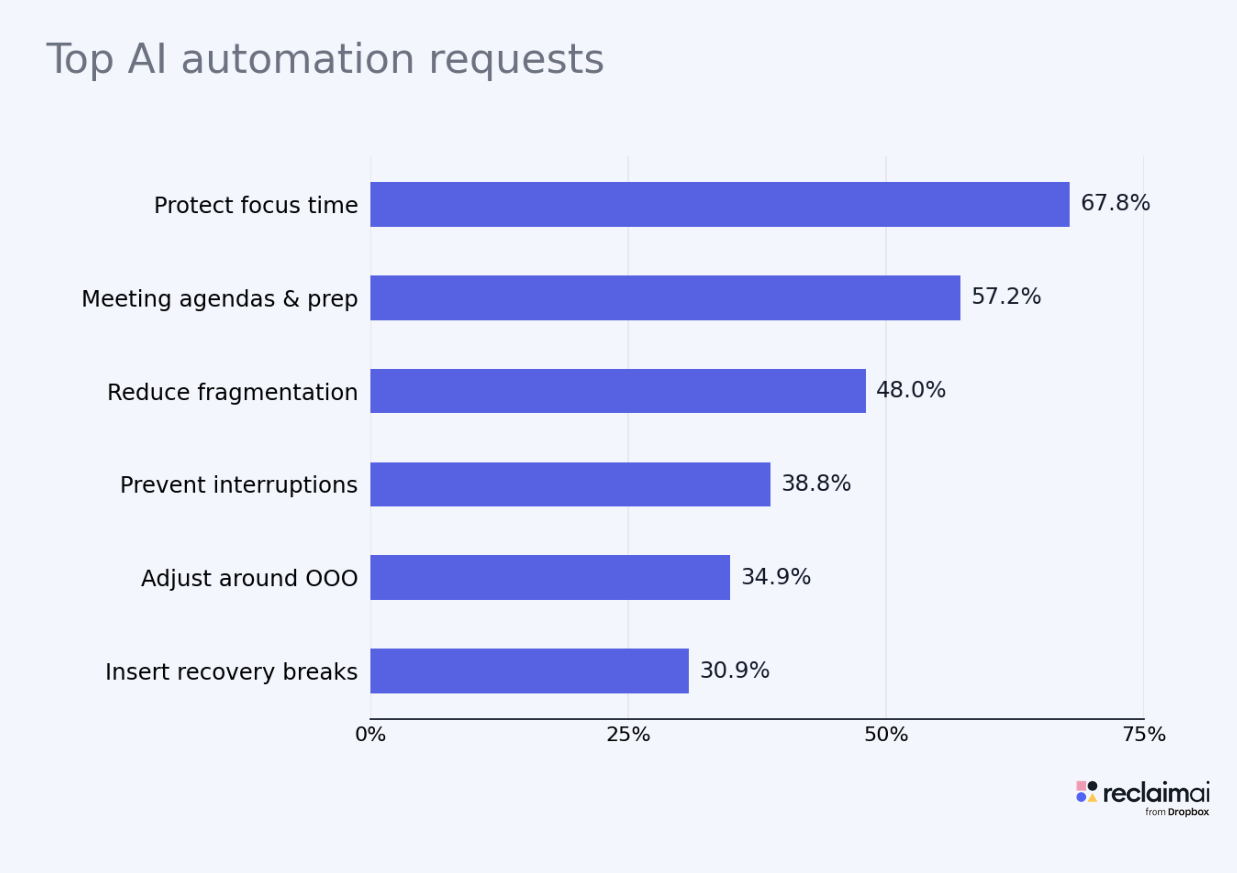
Top AI automation requests:
- 67.8% want AI to protect focus time goals
- 57.2% want AI to generate meeting agendas and prep materials
- 48.0% want AI to automatically reschedule meetings to reduce fragmentation
- 38.8% want AI to prevent interruptions during focus and key meetings
- 34.9% want AI to adjust meetings and work around team OOO schedules
- 30.9% want AI to insert recovery breaks between meetings
The strongest signal is focus protection. More than two-thirds of respondents selected AI that could guarantee or defend focus time goals, for example, protecting 20 hours/week for engineers.
The second strongest signal is meeting prep. 57.2% want AI-generated agendas and prep materials, suggesting that workers are not only overloaded by meetings themselves, but also by the surrounding work required to make meetings useful.
Nearly half of respondents want AI to automatically reschedule meetings to reduce fragmentation, suggesting that the problem isn’t just how many meetings there are, but how they’re distributed across the calendar.
AI demand clusters around focus, fragmentation & meeting quality
The AI automation results show three clear themes.
1. Protect the time people need to do real work
The top request, selected by 67.8%, is protecting focus time goals. This directly connects to the deep work gap: employees need 5.1 deep work sessions per week, but only get 3.7.
2. Reduce calendar fragmentation
48.0% want meetings automatically rescheduled to reduce fragmentation. That means people are not just asking for fewer meetings. They are asking for smarter placement of meetings.
A calendar with six meetings can be manageable if meetings are clustered well. The same six meetings can destroy productivity if they are scattered across every possible focus block.
3. Make meetings more worth the time
57.2% want automatic agendas and prep materials. This suggests that meeting quality is becoming just as important as meeting quantity.
If meetings are going to consume nearly 16 hours per week, employees need those meetings to be better prepared, more intentional, and easier to act on.
Employees want AI assistance with control
The survey also asked how much control vs. automation people want in meeting scheduling.
The results point to a clear preference for balance. Teams are not looking to hand over their calendars entirely, they want AI to assist, not replace decision-making.
The most common preference is 50% automation, selected by 42.9% of respondents. This represents a clear human-in-the-loop sweet spot: AI handles routine scheduling, while people stay involved in higher-stakes decisions.
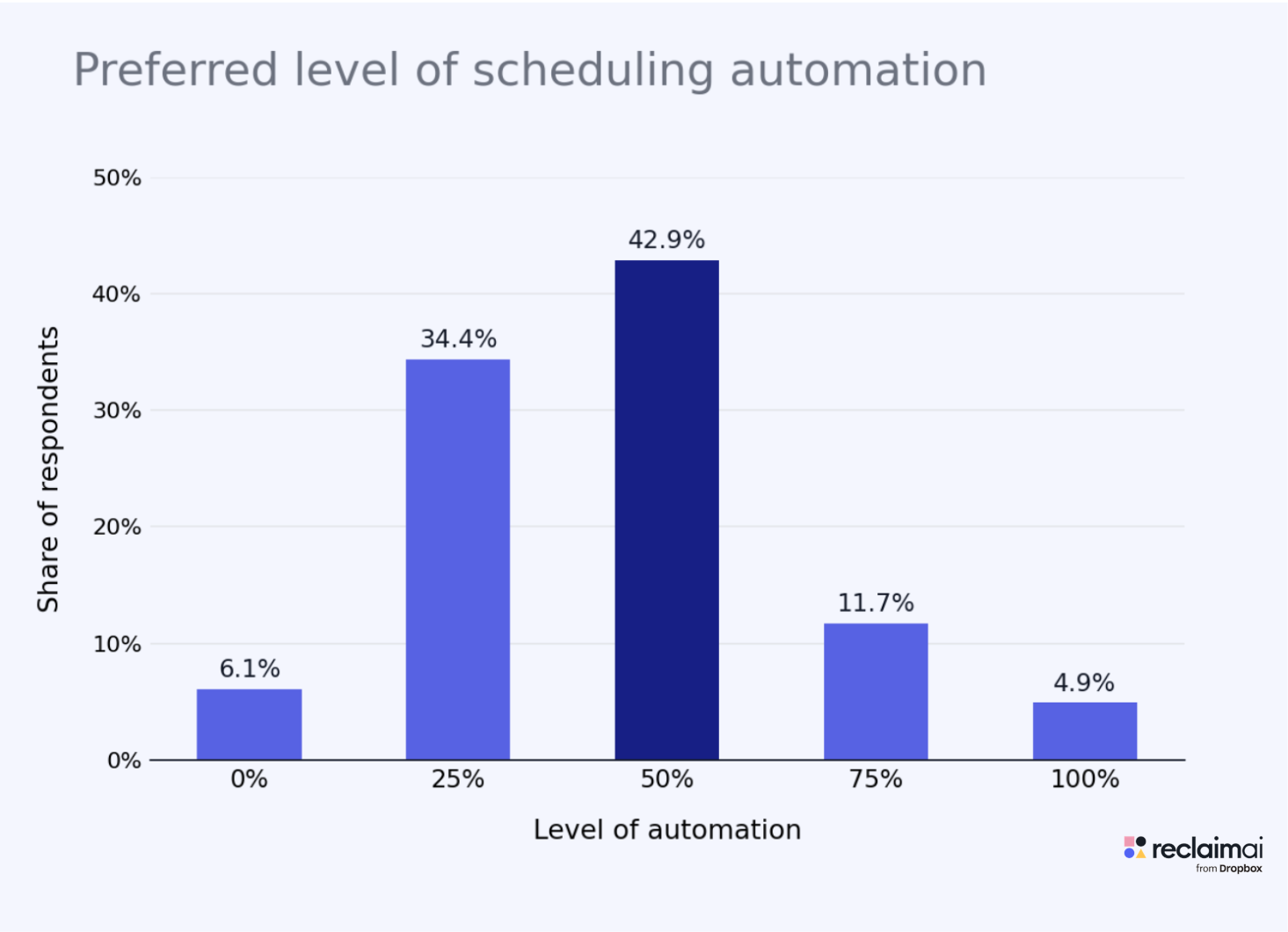
On average, respondents prefer 43.7% automation, reinforcing that the ideal model is neither fully manual nor fully autonomous.
Scheduling automation preferences:
- 6.1% want 0% automation
- 34.4% want 25% automation
- 42.9% want 50% automation
- 11.7% want 75% automation
- 4.9% want 100% automation
Key takeaways:
- 77.3% prefer 25–50% automation (human-in-the-loop)
- 93.9% want at least some AI involvement
- Only 4.9% want fully autonomous scheduling
This is one of the most important findings in the dataset. The takeaway is not simply that teams want AI, it’s how they want to use it.
Employees are looking for systems that can handle routine coordination, suggest improvements, resolve low-risk conflicts, and surface tradeoffs, while keeping humans in control of the decisions that matter.
The future of work is human-in-the-loop calendar automation
Taken together, the findings show that productivity problems are increasingly calendar problems.
Employees need more deep work, but meetings consume nearly two workdays per week. They want AI to protect focus time, improve meeting quality, and reduce fragmentation. But they do not want to lose control of their schedules.
That points toward a specific future: not fully autonomous calendars, and not fully manual calendars, but intelligent calendar systems that can:
- Defend focus time before it disappears
- Move meetings to reduce fragmentation
- Preserve recovery time between collaboration blocks
- Prepare people for meetings automatically
- Adapt around OOO schedules and team availability
- Escalate important tradeoffs for human review
This is exactly where AI calendar systems become valuable: not by replacing human judgment, but by enforcing the work conditions people already know they need.
What these trends mean for teams
The data points to a consistent pattern: teams are not short on time, but on how time is structured and protected. Today, focus time is still treated as an aspiration. Individuals try to protect it on their own against calendars filled with meetings, interruptions, and shifting priorities.
But the data shows that productivity depends on it:
- 67.8% want AI to protect focus time goals
- 48.0% want AI to reduce meeting fragmentation
- 57.2% want AI to improve meeting preparation
- 77.3% prefer human-in-the-loop scheduling automation
This reflects a need for systems that can structure time at the organizational level, not just assist individual scheduling decisions.
Reclaim addresses this by applying scheduling policies and a human-in-the-loop AI assistant to continuously balance focus time, meetings, and priorities across teams.
The takeaway for teams is not simply to use more AI. It is to operationalize time, turning it into a measurable, enforceable part of how work is planned, allocated, and executed.