


You worked from 9 to 5. You were on calls, in Slack, answering emails, reviewing docs, bouncing between browser tabs. You're exhausted. But when you sit down to think about what you actually accomplished today, the list is blank. You can barely point to a single thing that moved forward.
You weren't slacking off. You were working the entire time. So where did eight hours go?
Say you had four or five meetings today, that added up to two and a half hours. That should leave most of the day for real work. But when you look at what you actually produced in the gaps between those meetings, the answer is close to nothing. You had the time. It was just sliced into unusable pieces.
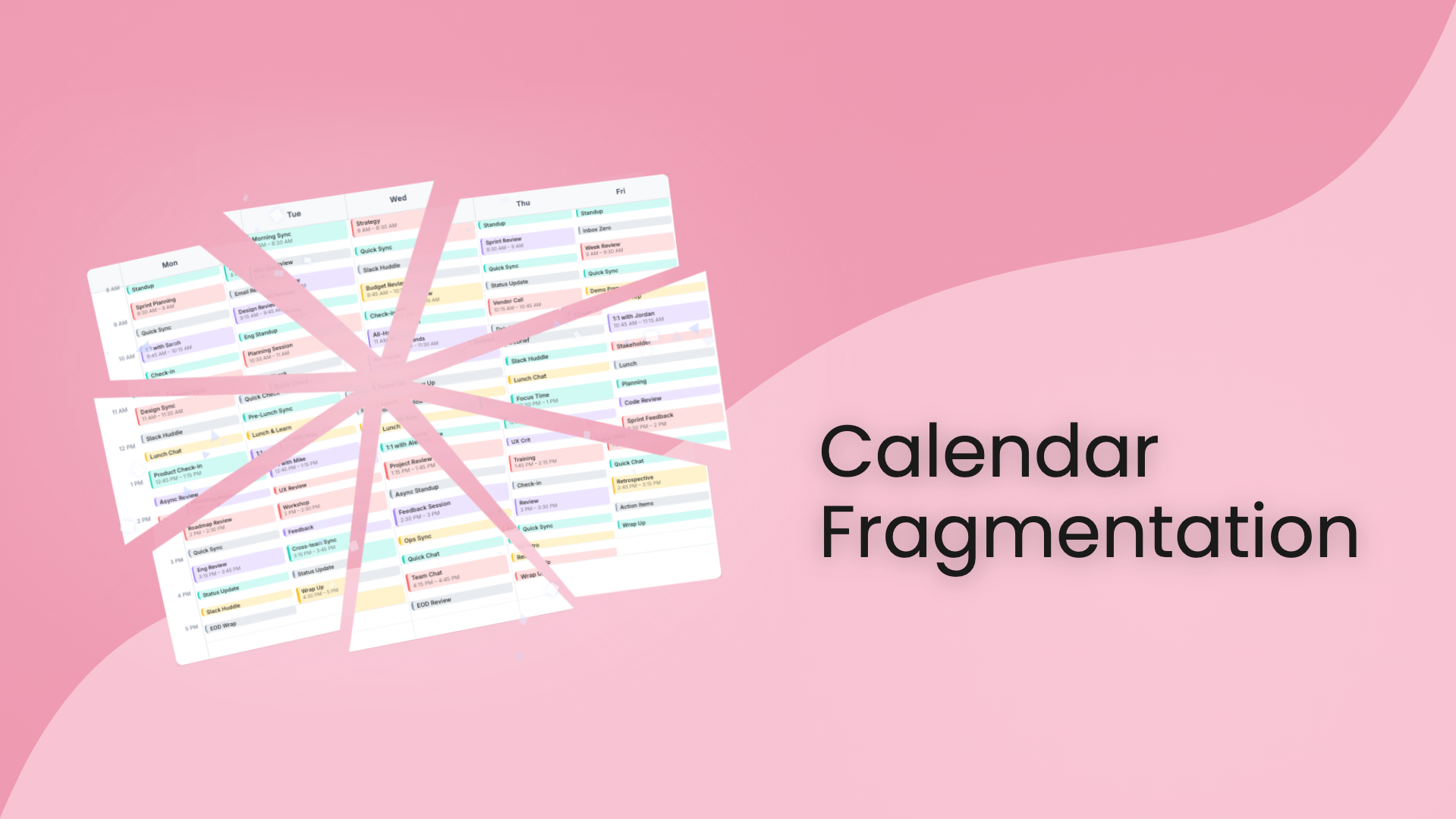
That pattern has a name: calendar fragmentation. And it's probably the single biggest drain on your productivity that nobody's measuring.
What is calendar fragmentation?
Calendar fragmentation is what happens when meetings and appointments scatter your workday into short, disconnected blocks, leaving gaps too small for real work but too frequent to ignore.
The term is borrowed from computer science. When a hard drive is fragmented, data is scattered in small pieces and the drive wastes time seeking between fragments instead of reading useful data. Your brain works the same way. A fragmented calendar means constant seeking (reorienting to half-finished tasks, re-reading the Slack thread you abandoned an hour ago) instead of the sustained, focused work that actually moves things forward.
It has less to do with how many meetings you have than with how they're distributed. Take two calendars with the exact same five meetings, totaling 2.5 hours:
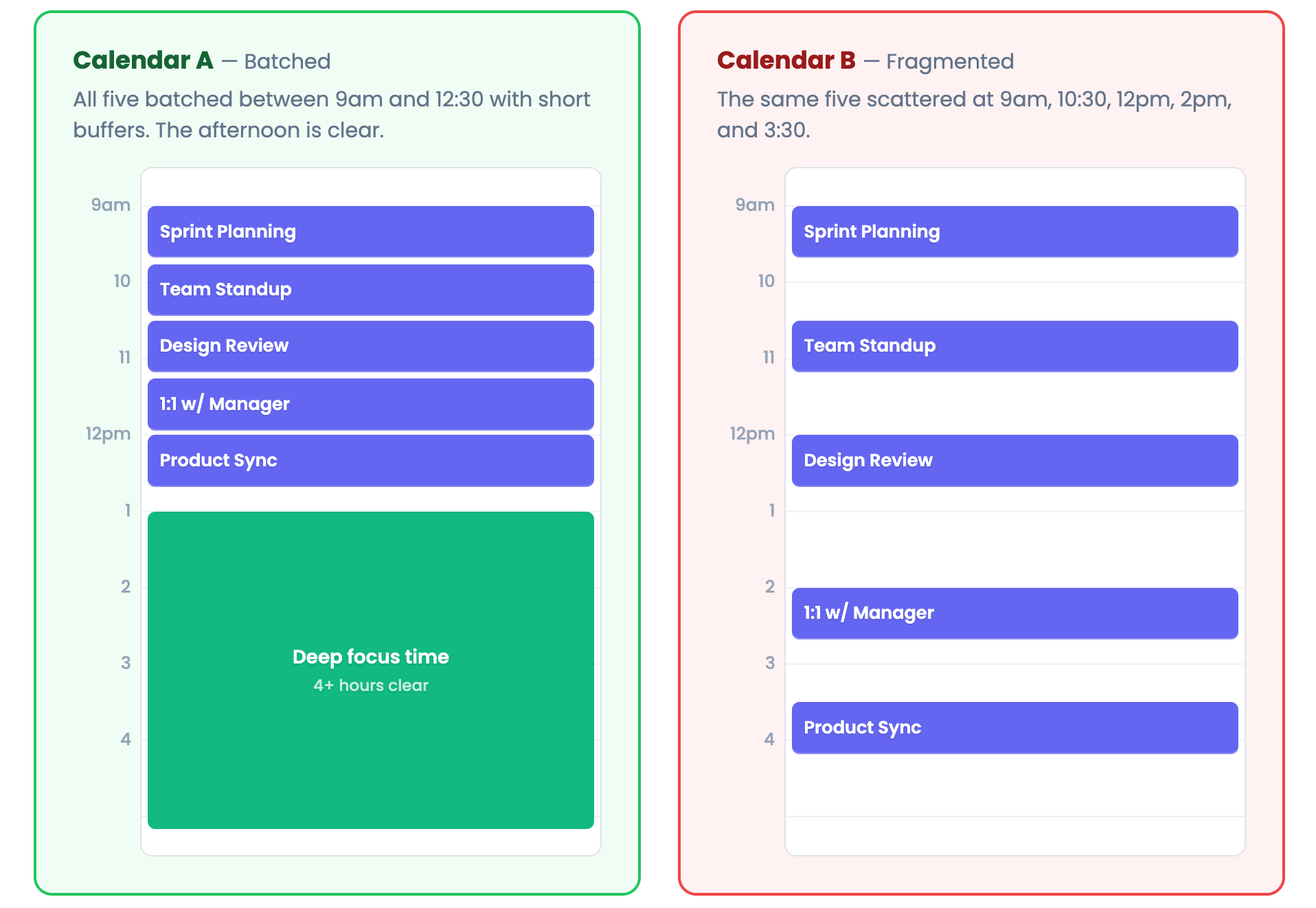
Calendar A gives you a 4+ hour block for deep work. Calendar B gives you four gaps of roughly an hour each. Technically open, but good luck getting anything done in them.
Same meetings. Same total hours. Completely different days.
Here's why those gaps don't work. The average knowledge worker stays focused on a single task for only 11 minutes before switching to something else. After each switch, it takes roughly 25 minutes to fully return to the original work, and you rarely snap right back. You bounce through two or three other things first before you circle back to what you were doing. An hour-long gap is barely enough to recover from one meeting before the next one starts.
Add those gaps up and might salvage less than an hour of genuine deep work. Employees average only 11.2 hours of productive work per week (roughly 2 hours a day) despite needing almost twice that. The meetings cost two and a half hours. The fragmentation cost you the rest.
And meetings are just one source. Research shows that 57% of all work segments get interrupted before completion. Emails, Slack pings, and notifications create their own micro-fragmentation within whatever gaps remain. You compensate by working faster, staying later, multitasking during calls. These habits mask the problem while deepening it. The layers compound, which is why fragmentation is so hard to escape once it takes hold.
The fragment trap: what actually happens in those gaps
The real damage from calendar fragmentation happens between meetings, in those 20-to-30-minute gaps where your productive day quietly falls apart. The pattern is so familiar you've probably stopped noticing it.
The anatomy of a 25-minute gap
Why 25 minutes? Because that's roughly how long the research says it takes to fully refocus after an interruption. A gap that's exactly as long as your recovery window is, in theory, just enough time to get back on track. Here's what actually happens. See if you recognize yourself:
But it didn't feel like zero. You were busy, you were responsive, and you have absolutely nothing to show for it.
Repeat this cycle four, five, six times a day, and you've got a full workday (8, 9, 10 hours) where you're lucky to get through half your planned tasks. The structure of your calendar made real work nearly impossible. Discipline had nothing to do with it.
About 40% of task switches are self-initiated. When you've been interrupted every 11 minutes for long enough, your brain stops waiting for the interruption and starts doing it for you. You check Slack before it pings. You open email out of habit. Fragmentation interrupts your work, and eventually it trains you to interrupt yourself.
Why your brain won't cooperate
Willpower won't save you here. Real cognitive forces are working against you.
Sophie Leroy calls it attention residue: when you switch tasks, part of your attention stays stuck on the previous one. After a meeting, your brain is still processing decisions, replaying conversations, tracking follow-ups, even as you try to focus on something new. That residue doesn't clear in a few minutes. It lingers, degrading your focus on whatever you try to do next.
And when you do return to an interrupted task, the path back is rarely direct. Field studies found people pass through an average of 2.26 other activities before circling back to the original work. In a 25-minute gap, the residue may never fully clear at all.
Every half-read email and abandoned Slack draft gets lodged in working memory as an open loop (the Zeigarnik Effect). By midday, you're carrying a dozen of these. Starting anything new feels like pushing through fog, so your brain defaults to what's easy: Slack, email, tiny dopamine hits that feel productive but produce nothing.
Then there's what you might call the countdown effect. Knowing a meeting is 20 minutes away creates a real psychological barrier to starting deep work. Your brain has already registered the upcoming interruption, so it steers you toward shallow tasks instead. Same reason you don't start a movie when you have to leave in 30 minutes, except at work, you make this calculation six or seven times a day.
The real cost of fragmentation
Most people get the math on meetings completely wrong.
Four 30-minute meetings in a day? That's 2 hours. Subtract from an 8-hour workday and you've got 6 hours for everything else. Plenty of time.
That math is wrong because it only counts the meetings themselves. Every scattered meeting also costs you the recovery time afterward, the dead gap before it you couldn't use because you knew an interruption was coming, and the mental overhead of tracking what's next. Those hidden costs dwarf the meetings.
Four scattered 30-minute meetings don't cost 2 hours. They cost closer to 5. The meetings were the smaller expense. Everything around them ate the day.
Fragmentation is also selective about what it destroys. Research found that interruptions actually improve performance on simple tasks (the easy stuff gets done fine). But they significantly degrade performance on complex tasks: the deep analysis and strategic thinking that represents your most valuable output. Fragmentation lets the shallow work through and punishes the work that matters.
How it scales
The individual math is bad enough. The average knowledge worker achieves roughly 2 hours and 53 minutes of actual productive work per day, and context switching alone consumes up to 40% of productive time. But the damage compounds as you move up and across the org.
Managers spend 23+ hours per week in meetings (ICs average about 6). Researcher Joseph A. Allen calls the cognitive cooldown after bad meetings "Meeting Recovery Syndrome". For a manager with 8+ meetings a day, MRS is the workday. The calendar crowds out strategic thinking and coaching, and productivity drops 41% once meetings consume more than 60% of the day.
At the org level, context switching costs the U.S. economy an estimated $450 billion annually. Nearly 79% of workers say meeting overload prevents them from completing their actual work, and 1 in 3 say the current pace is flat-out impossible. No amount of individual discipline fixes a systemic scheduling problem.
How to defragment your calendar
Calendar fragmentation is solvable. Meetings serve a real purpose, and the goal here is to change how they're distributed so that both meeting time and focus time get contiguous blocks instead of scraps.
There are three levels to work at:
1. Run a personal calendar defrag
Open your calendar and audit every recurring meeting. Sort them into three buckets: meetings you own and can move, meetings you attend but could influence, and meetings that are fixed. For the first two buckets, ask: Can it be shortened? Combined with a similar meeting? Replaced with an async update? Most people find that 20-30% of their recurring meetings are hard to justify once they actually stop and evaluate them.
2. Consolidate your meetings
The specific tactic depends on your role: batch meetings into 1-2 dedicated days or daily blocks (mornings only, for example). If full batching isn't possible, edge-load: push meetings to the first or last two hours of the day so the middle stays clear. Either way, the goal is to create at least one contiguous block of 2+ hours every day. Protect that block the way you'd protect a meeting with your most important client.
3. Block focus time first, not last
Don't wait for meetings to fill your calendar and then try to find focus time in the leftovers. Schedule 90-minute deep work blocks first, and let meetings fill around them. If focus time isn't on the calendar, it doesn't exist and someone will schedule over it.
4. Use a "ready-to-resume" plan
This comes straight from Leroy's attention residue research: when you're about to be interrupted (a meeting is coming, someone needs your attention), take 30 to 60 seconds to write down exactly where you are and what your next step will be when you return. Something like: "Finished section 2 analysis. Next: compare Q3 vs Q4 numbers in the revenue sheet, row 47." This micro-ritual significantly reduces attention residue and makes resumption faster and less painful. It turns an abrupt stop into a planned pause.
5. Stop defaulting to Slack in gaps
When you do end up with a 15-20 minute gap, resist the pull of Slack and email. Instead, keep a running "micro-task list" of pre-vetted items that take under 5 minutes and don't require deep focus: clearing out your downloads folder, submitting an expense report. These are better uses of short gaps than passively scrolling channels, because they produce actual output without creating attention residue.
1. Institute no-meeting days
Give the team at least one guaranteed no-meeting day (or half-day) per week with zero scheduled meetings. Treat it as a structural investment in the team's ability to do deep work. Even one meeting-free afternoon per week gives everyone a protected block they can count on for their most demanding tasks.
2. Create a meeting budget
Make the trade-off explicit: every meeting scheduled is focus time removed from someone's calendar. Some teams cap meetings at 40% of the workweek and track it the same way they'd track a financial budget. When you hit the cap, adding a new meeting means cutting an existing one.
3. Reduce the always-on layer
When researchers at UC Irvine cut off email access entirely for five workdays, participants multitasked less, spent longer in each application window, showed lower physiological stress, and described the experience as working at "a pace not dictated by electrons." You don't need to go that far, but batching email and Slack into designated windows rather than leaving them always-on can meaningfully reduce the micro-fragmentation that happens between meetings. Apply the same logic to meetings themselves: status updates, FYIs, and low-stakes decisions rarely need a real-time call. Written stand-ups, recorded Loom walkthroughs, and shared docs can replace a surprising number of recurring syncs.
4. Mandate buffer time
Even a 5-minute gap between meetings prevents the compounding exhaustion of zero-gap back-to-backs. Microsoft's own workplace research found that back-to-back virtual meetings measurably increase stress and reduce the ability to focus and engage, while even short breaks between meetings improve both. Default to 25-minute or 50-minute meetings instead of 30 and 60. It doesn't fix fragmentation on its own, but it gives people the minimum breathing room needed to transition between contexts without carrying as much attention residue into the next call.
The uncomfortable truth about manual calendar defragmentation is that it's fragile. It works until someone drops a "quick 30-minute sync" into your carefully protected focus block, and then it doesn't. Maintaining a defragmented calendar by hand is like manually defragmenting a hard drive every week. Possible, but nobody sustains it.
This is where AI-powered scheduling earns its value. Reclaim.ai approaches the problem from the other direction: instead of requiring you to manually defend focus time against incoming meetings, it detects open blocks and proactively protects them, coordinates across attendees' calendars to place meetings in low-fragmentation slots, and inserts buffer time between meetings automatically. When tasks hit your list, they get scheduled into real calendar blocks based on priority and available time instead of sitting on a static list competing with your calendar for attention.
The difference between manual and tool-assisted defragmentation is sustainability. You can batch your meetings this week and run a one-time audit. But without a system that continuously defends your time as new meetings arrive, fragmentation creeps back within days. Automation keeps the calendar defragmented by default, so you can focus on the work instead of the meta-work of managing your schedule.
Not all free time is equal
Calendar fragmentation feels like a personal failure. I should be getting more done. But the problem is upstream of you: most calendar tools treat all "free time" as equal. A 20-minute gap between meetings looks the same as a 3-hour open block, both empty white space, available for anyone to claim. One can hold deep, complex work, the other can barely hold a Slack scroll.
Until calendars understand that distinction, you'll keep ending long days wondering where the time went. The fix is a smarter distribution of the meetings you already have, a consolidated calendar where both meetings and focus time get real, uninterrupted space.
Productivity Trends Reports