.png)


Modern work isn’t short on effort — it’s short on focus. New 2026 SXSW survey data, captured live at the event in Austin, Texas, reveals how teams actually spend their time and why focus is increasingly hard to find.
Across hundreds of survey responses, a consistent pattern emerges: employees are spending significant time in meetings, dealing with constant interruptions, and struggling to find uninterrupted time for meaningful work. While calendars may be full, focus is fragmented, and for many, deep work is increasingly rare.
Report overview:
- Employees average 11.8 hours/week in meetings
- Employees need 36.8% of their time for deep work
- 55.9% of employees get 2 or fewer deep work sessions/week
- Top 3 work challenges in 2026:
- 52.9% have too many meetings
- 46.5% lack focus time to do their work
- 46.1% face constant interruptions (like Slack and email)
Together, these findings point to a structural productivity problem: work isn’t just busy — it’s fragmented by meetings, interruptions, and context switching, leaving little room for sustained, high-value focus.
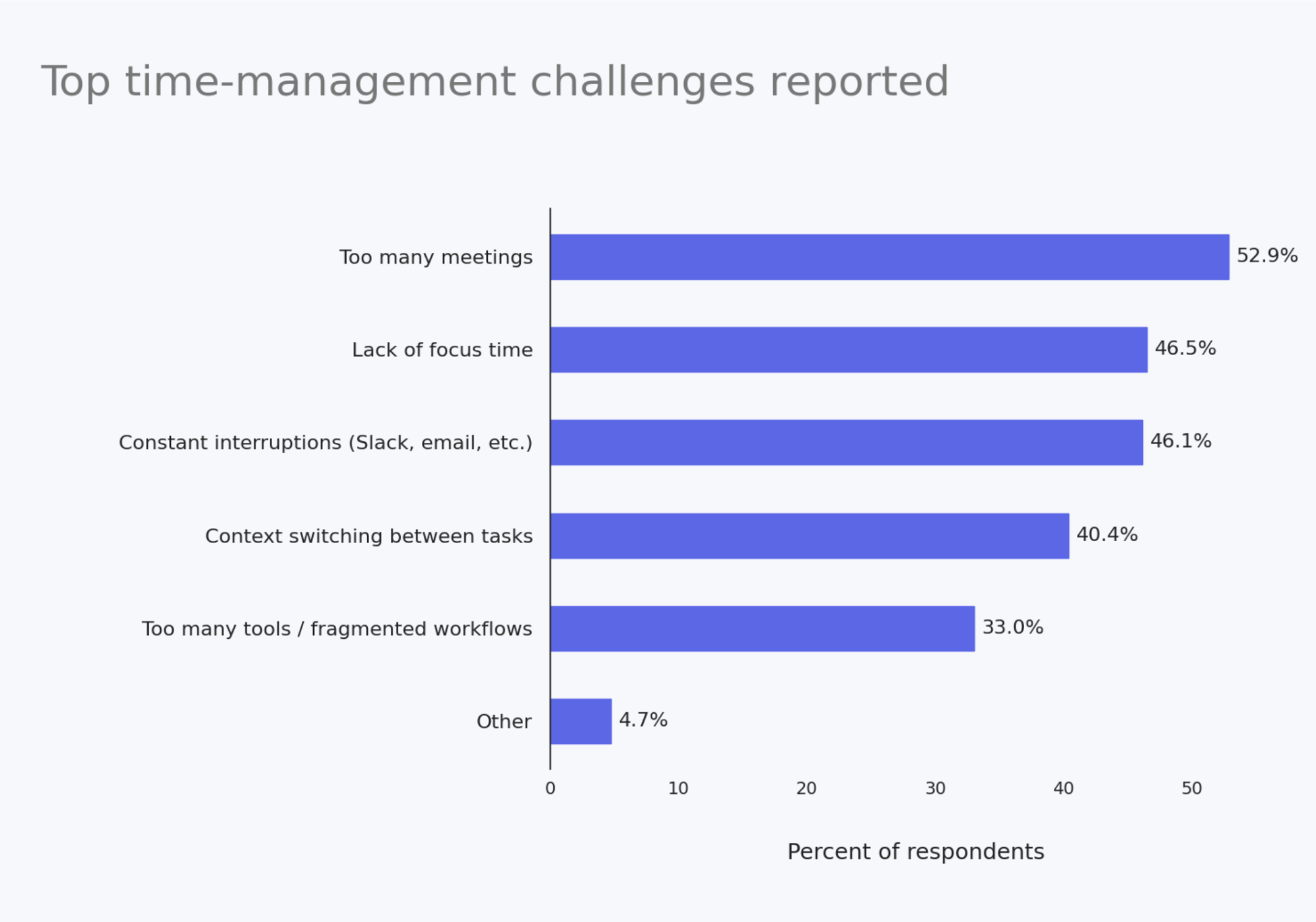
Top work challenges in 2026: 52.9% cite “too many meetings”
Meetings are the most commonly cited challenge in the survey, but they are not the only source of disruption. Employees also point to interruptions, context switching, and fragmented workflows — suggesting the real issue is not just how much time work takes, but how often that time gets broken apart.
- 52.9% cite “too many meetings”
- 46.5% cite “lack of focus time”
- 46.1% cite “constant interruptions like Slack and email”
- 40.4% cite “context switching between tasks”
- 33.0% cite “fragmented workflows across too many tools”
- 4.7% cite “other”
These challenges rarely show up in isolation – on average, employees face 2.2 of these top challenges at work. They compound one another, creating a workday where attention is repeatedly redirected and progress is harder to sustain. The result is not just less time for focused work, but less usable time overall.
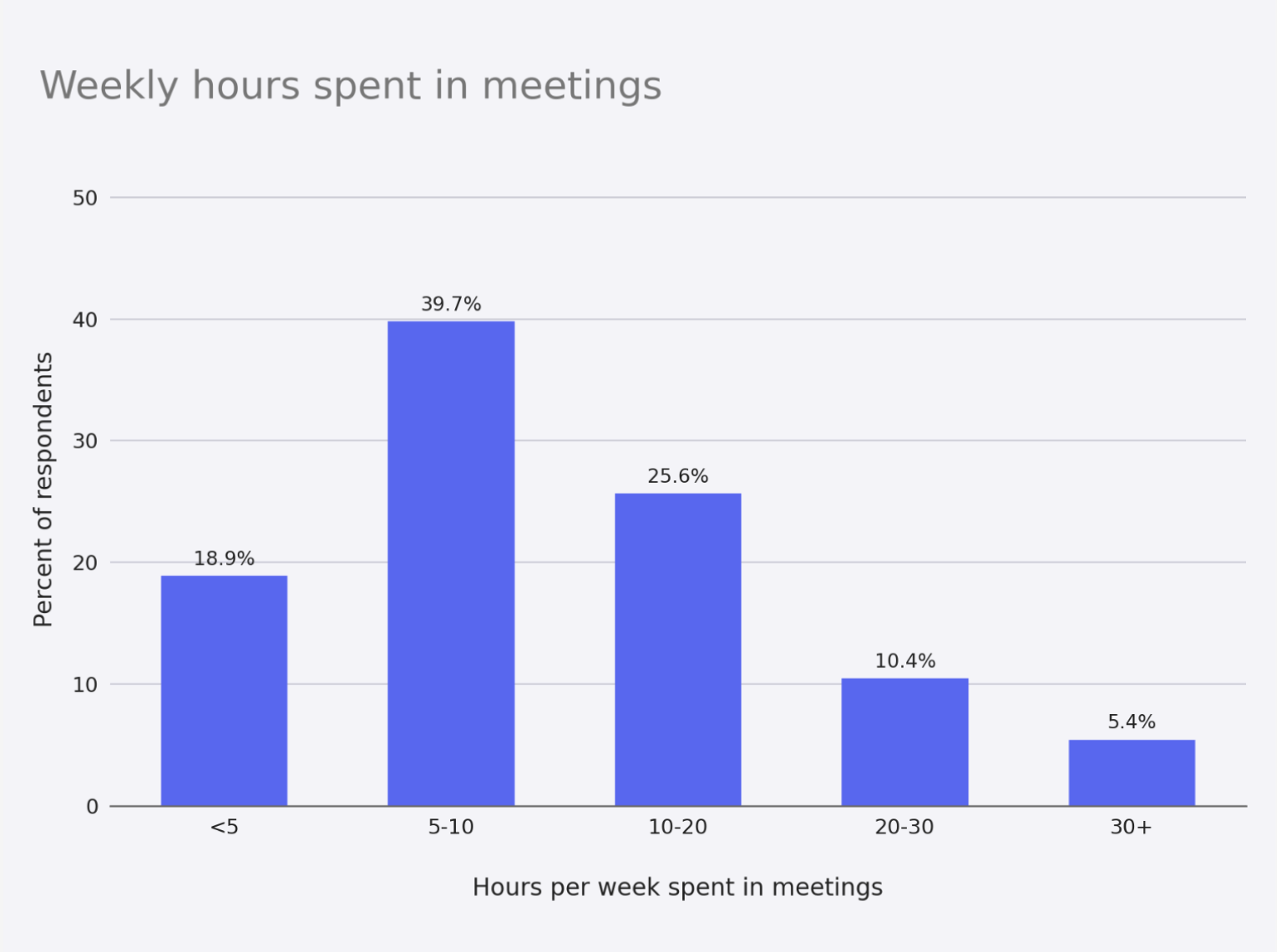
Employees average 11.8 hours/week in meetings
For many employees, meetings are no longer occasional coordination points — they are a defining part of the workweek. Based on the survey distribution, participants spend 11.8 hours/week in meetings on average, suggesting that a meaningful share of the workweek is already committed before deep work begins.
- 18.9% spend 0–5 hours/week in meetings
- 39.7% spend 5-10 hours/week in meetings
- 25.6% spend 10–20 hours/week in meetings
- 10.4% spend 20-30 hours/week in meetings
- 5.4% spend 30 or more hours/week in meetings
65.3% spend 5–20 hours/week in meetings
Meetings are a regular part of the workweek, not an occasional interruption. 65.3% of employees spend 5–20 hours a week in meetings, and another 15.8% spend more than 20 hours in meetings, showing that for a meaningful share of employees, calendars are dominated by synchronous work.
That matters even more in organizations where much of the work depends on sustained concentration. Typically, 77% of the org is made up of individual contributors, yet only 58.6% of employees spend less than 2 hours a day in meetings. For many ICs, having 25% of the workday consumed by meetings represents a meaningful loss of time that could otherwise support deep work.
As meeting load increases, uninterrupted focus becomes harder to protect. And this is not just about total time spent in meetings. Even a small number of meetings, if spread across the day, can fragment time and make deep work harder to sustain.
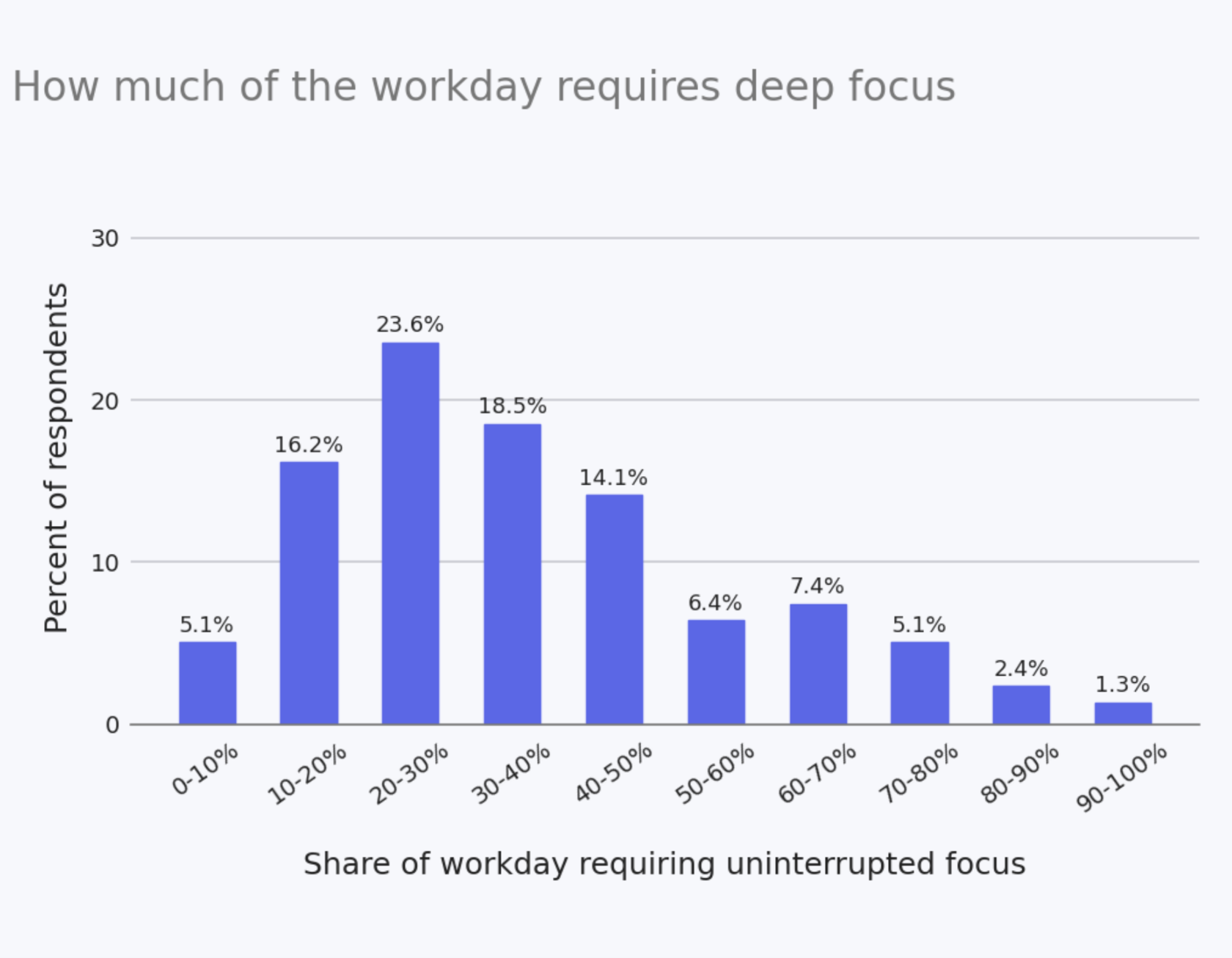
Employees require uninterrupted deep work for 36.8% of the workday
On average, employees say 36.8% of their workday requires deep, uninterrupted focus time, showing that concentrated, high-impact work is a necessity for many employees. But the more important signal is the wide spread in responses, which points to meaningful differences in focus time needs across roles and departments.
22.6% of employees require deep work for at least half of their workweek, including 8.8% who need 70% or more to achieve their goals. Another 42.1% place that need at 20–40% of the week, balancing focused work alongside meetings and shallow work. At the lower end, 21.2% say 20% or less of their workday needs to be dedicated to deep work, likely reflecting managers and other roles centered more on coordination, oversight, and supporting knowledge workers.
Taken together, the distribution shows there is no single “normal” focus requirement across the org. Deep work needs vary meaningfully by role, and that variation matters when evaluating how well calendars and schedules support different kinds of work.
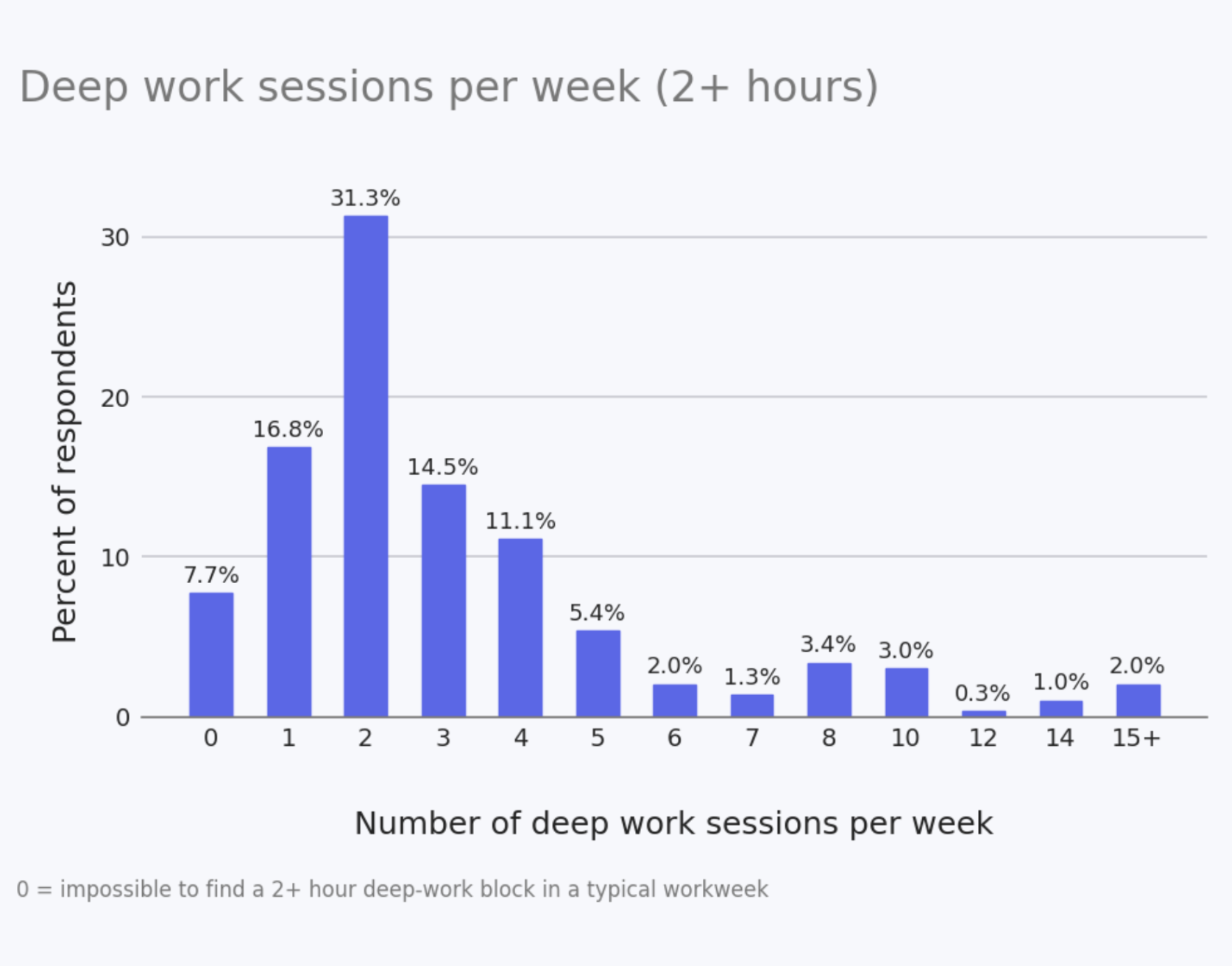
70.4% of employees get 3 or fewer deep work sessions/week
That mismatch becomes even clearer in the weekly data: 70.4% report 3 or fewer deep work sessions per week (2+ hour focus sessions), and the median employee gets just 2. 7.7% say they cannot find even one 2+ hour deep work block in a typical week. The pattern suggests that deep work is not simply being deprioritized — it is being crowded out by the structure of the week itself.
What’s especially striking is that only 18.5% of employees get 5 or more deep work sessions per week — the equivalent of just 1 per workday. On average, employees get only 3.2 deep work sessions per week.
For many employees, focused work appears less like a built-in part of the week and more like something that only happens when meetings, messages, and shifting priorities leave enough space. That makes it harder to build momentum on complex work or stay in a single thread of thought long enough to make meaningful progress.
Over time, the challenge is not just that deep work happens less often, but that the time needed for it becomes harder to predict and protect.
Why manual time management is no longer enough
Most productivity systems assume people can protect their time on their own. But with constant interruptions, shifting priorities, and dynamic meeting schedules, the issue is no longer just busyness, it is fragmentation.
A few of the biggest focus time offenders:
- Employees need 23 minutes and 15 seconds to regain focus after an interruption.
- The average Slack user spends about 90 minutes a day in Slack.
- Employees spend roughly 28% of the workday on email.
- Workers receive around 200 notifications each day.
- Managers spend 35% to 50% of their time in meetings, depending on seniority.
The result is a workday that becomes reactive by default, where focus has to be constantly defended and deep work becomes harder to sustain.
High-performing teams create better conditions for deep work
Across responses, there’s a clear difference between teams that struggle to focus and those that don’t. The difference is not effort, it’s whether time is structured to support sustained focus.
A few signals from related deep work research:
- Deep work can drive up to 500% higher productivity when people have enough uninterrupted time to focus.
- It takes about 15–20 minutes to reach a productive flow state, so short or broken blocks often fail to deliver meaningful focus.
- The average employee is interrupted 31.6 times per day, making sustained concentration harder to maintain.
- Employees report wanting 8.1 more hours per week for productive, heads-down work.
High-performing teams are not necessarily less busy. They are better at structuring time in ways that make deep work more possible.
Using AI to protect focus & reduce fragmentation
As work becomes more dynamic, static scheduling approaches struggle to keep up. More adaptive AI systems are beginning to address this by:
- Identifying where focus time can exist
- Protecting it before it gets filled
- Adjusting schedules as conditions change
- Reducing unnecessary fragmentation across the day
Instead of relying on individuals to manually defend their time, these systems help ensure that time is structured in a way that supports sustained work. This is particularly important in environments where coordination demands are high and constantly shifting.
Turning insight into action with Reclaim
Reclaim.ai helps teams protect meaningful work time by automatically defending focus time around meetings, adapting as priorities change, and reducing calendar fragmentation across the day. Connected directly to your calendar, Reclaim creates more space for sustained work and helps teams use their time more intentionally instead of constantly reacting to a crowded schedule. On average, Reclaim users report 7.6 more productive hours per week, 2.3 fewer bad meetings, and 49% less time waste. These outcomes reflect both stronger execution and healthier ways of working.
At the organizational level, Reclaim supports company-wide rollout with SCIM provisioning and helps teams align around shared goals for focus time, meeting reduction, and calendar health through Enterprise initiatives.
Productivity Trends Reports