


About 90% of CEOs believe that by 2028, AI will redefine what success looks like in their industry. Four in five are more optimistic about the ROI of their AI investments than they were a year ago, and 88% of organizations already use AI in at least one business function.
Nearly all CEOs expect AI agents to produce measurable returns in 2026, and corporations broadly plan to double AI spending as a share of revenue in the year ahead.
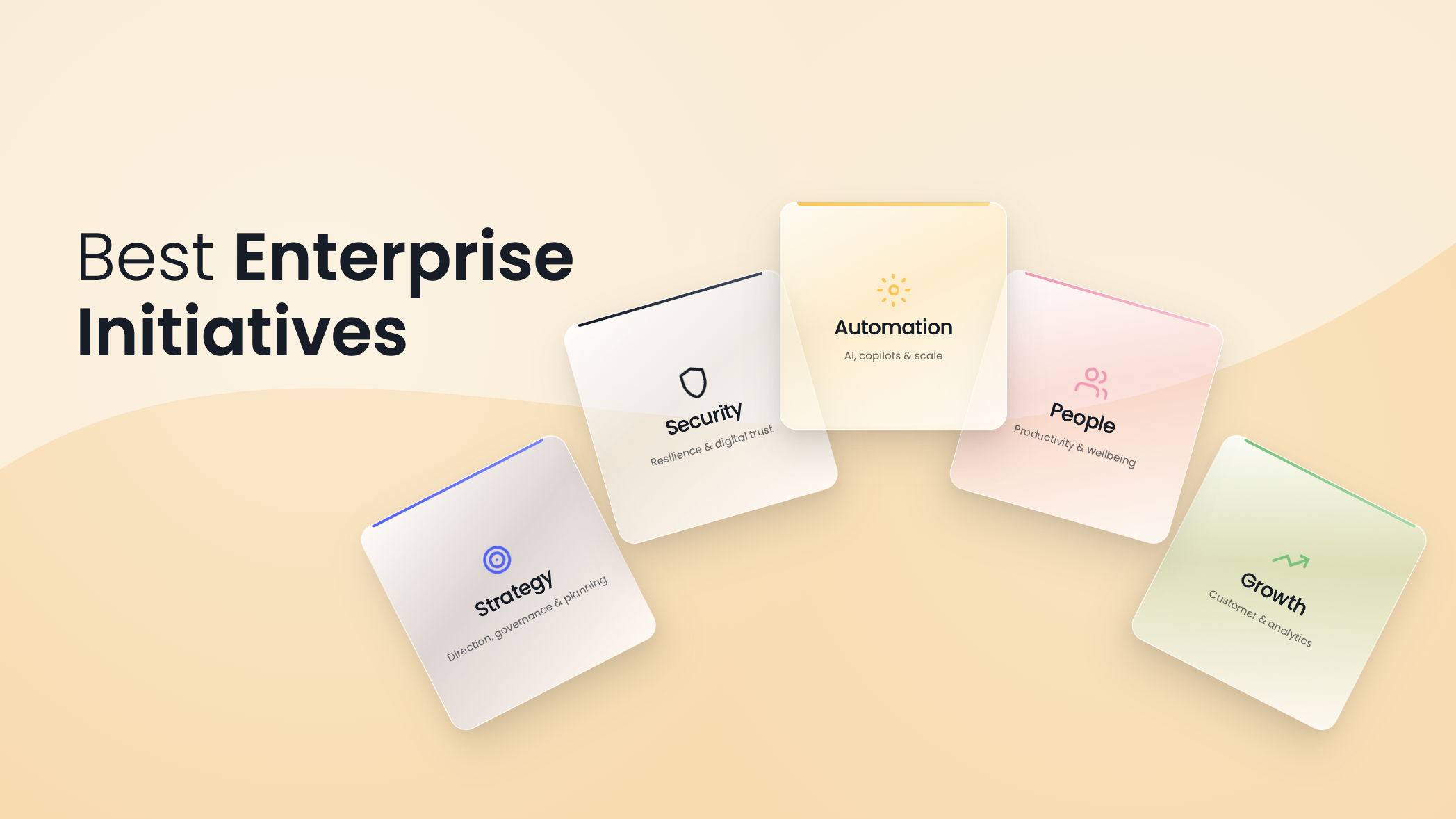
This guide maps out 19 enterprise initiatives across six categories (strategy, infrastructure, security, workforce productivity, operations, and growth), drawing on the latest research from McKinsey, Deloitte, Forrester, and BCG. For each one: what it does, why it matters now, and what the research says about the return.
Top Enterprise Initiative in 2026
Before deploying AI technologies into workflows, the most successful organizations get the foundation right: skills, governance, strategic alignment, and financial agility. Skip this section at your own risk. We consistently see enterprises invest heavily in AI tools and then wonder why adoption stalls. The answer is almost always somewhere in these four initiatives.
1. AI adoption & upskilling
AI adoption and upskilling is the number one enterprise-wide push to build practical AI skills and working habits so investments in new tools translate into daily use, not one-off pilots that stall.
70% of AI's value comes from workforce transformation and behavioral change. Not from algorithms (10%). Not from technology implementation (20%). From people learning to work differently. Which explains why only 5% of organizations have seen substantial financial gains despite near-universal AI adoption.
The ROI data shows returns between 106–353% when upskilling accompanies implementation. And the companies at the head of the pack are allocating 60% of their AI budgets to upskilling (vs. 24% for followers), and spend over eight hours per week on personal AI learning. They're doing it themselves, not delegating it.
2. AI governance & responsible AI
AI governance and responsible AI initiatives are rolling out to document rules, access limits, monitoring, and audit requirements for models and agents, including what employees may and may not send to vendors.
This one is uncomfortable to talk about honestly, so most articles don't. But here's what's happening: Only 31% of organizations have a formal, comprehensive AI policy. Shadow AI is rampant, with employees routinely adopting tools without IT approval or visibility.
Fewer than 1% of organizations have fully operationalized responsible AI, while 81% still remain in the earliest stages of maturity. Meanwhile, 83% plan to deploy autonomous AI agents in the near future, but only 29% feel equipped to secure those systems.
An effective governance initiative establishes acceptable use policies, agent guardrails with live monitoring, audit trails, and clear boundaries between authorized and unauthorized AI usage. None of this is glamorous work. But it determines whether every other initiative on this list succeeds safely or creates hidden risk.
The organizations doing this well treat it as proactive risk management, not a compliance checkbox. They make governance easy to follow so employees don't have to route around it.
3. OKR alignment & dynamic strategic planning
OKR alignment and dynamic strategic planning enterprise initiatives involves tying objectives and key results to workforce time allocation to ensure time spend is aligned with company priorities.
Every enterprise company sets OKRs for their work groups. Almost none of them protect and track time for those priorities, and only 13.7% of company executives fully understand their employees productivity.
For example, take a division leader who sets a flagship goal for the quarter. Let’s say, a major product launch. Week to week, status reviews and written updates suggest things are under control: milestones move, risks have owners, and the program tracker mostly stays in a comfortable band. By the end of the quarter, though the work is still far behind. Competing priorities consumed most of the calendar, and almost no hours were actually protected for the initiative itself. That work gets done in whatever gaps survive between recurring meetings. Project management tools log tasks and RACI charts, but they do not create execution time. So critical initiatives stall and the gap between strategy and capacity only becomes undeniable when deadlines slip.
An OKR alignment initiative closes that gap by connecting strategic objectives to operational execution, and increasingly, to calendar-level scheduling. AI can allocate execution hours for priority workstreams and continuously rebalance as schedules shift. Reclaim does this by mapping workstreams directly to protected calendar time, with analytics that show whether time allocation actually matches strategic intent. When conflicts arise, lower-priority work moves first, so the most important work keeps its protected time.
The real shift here is from individual discipline to organizational policy. You stop asking people to personally defend their priorities and start building that defense into the system.
4. Agile budgeting & dynamic resource allocation
Agile budgeting and dynamic resource allocation is a new initiative strategy that’s gaining momentum, where organizations are revisiting forecasts and moving budgets on a quarterly or monthly rhythm, instead of one fixed annual envelope.
Annual budgets are forecasted bets placed 12 months in advance. When AI capabilities, costs, and market trends shift quarterly, that's a long time to be locked in. The formal plan and funding can point at what's next, while everyone is still delivering what we already promised, unless you explicitly adjust the plan when the world shifts.
62% of IT and business executives expect more than 100% ROI from agentic AI systems that analyze performance data and reallocate resources on shorter cycles. While 85% of executives recognize agility as critical, 65% admit they've implemented it only to a limited extent or not at all.
The gap is rarely technological. It's the company’s own incentive structures and approval chains that are still designed for a slower world. Rolling forecasts, outcome-based funding models, and AI-powered scenario planning are all available now. The hard part is convincing a CFO to abandon the annual cycle they've run for 20 years.
5. Knowledge management & intelligent enterprise search
Knowledge management and intelligent enterprise search initiatives are enterprise-wide pushes to unify findability across apps (with permissions enforced and sources cited) so people recover the hours they lose hopping between siloed tools.
The search problem is ultimately a time problem. Every minute someone spends hunting for a document in Slack, to checking Confluence, then asking a colleague on Teams, to finally finding the answer in a Google Doc (with an unhelpful title) is time wasted that could have been spent on something productive. Knowledge workers lose hours each week to the operational friction of just finding the information they need to do their actual work.
47% of digital workers struggle to find the information they need to do their jobs effectively. AI-powered enterprise search changes the model entirely: instead of searching five tools and piecing together an answer, employees ask one question and get a sourced, permissions-aware response.
Dropbox Dash is a strong example of where this category is heading. It connects across SaaS tools and uses a knowledge graph to map relationships between people, documents, and workflows, so search results come back with context rather than just keyword matches. The 305-app average we cited in #7 is also the 305-silo problem this initiative solves.
You can buy all the AI tools you want, but they're only as useful as the data and infrastructure behind them. These three initiatives address the layers that enterprise AI applications depend on.
6. Data platforms & "intelligent enterprise" architecture
Data platforms and "intelligent enterprise" architecture initiatives are cross-company efforts to standardize pipelines, storage, and access patterns (often lakehouse, mesh, or fabric-style designs) so analytics and AI draw from the same governed datasets instead of conflicting copies.
Every AI tool is only as good as what it can connect to. When a customer's HR data lives in one system, their calendar in another, and their project management in a third, the AI scheduling layer can only optimize what it can see. Multiply that across every AI tool in the stack and you understand why data architecture is a prerequisite, not a nice-to-have.
Three modern approaches are gaining traction.
- Data lakehouses combine the flexibility of data lakes with the governance of data warehouses, built on open standards like Apache Iceberg.
- Data mesh decentralizes ownership, letting domain teams manage their own data as a product.
- Data fabric uses AI-powered metadata analysis to automate management across distributed sources, with the market projected to grow from $3.1 billion to $12.5 billion by 2035.
What they share: shared storage, modular compute, real-time streaming, and governance built in rather than bolted on. If you're still running a monolithic data warehouse, every initiative downstream is working with one hand tied behind its back.
7. Data governance & data quality
Data governance and data quality enterprise initiatives assign named owners, set standards, and fix wrong or missing fields before that data trains models or feeds executive metrics, so AI and reporting don't amplify bad inputs.
A familiar pattern shows up long before anyone blames the model: leadership notices that regional revenue in an executive dashboard doesn't match what sales reports in the CRM, and the root cause is almost always dirty data upstream, like duplicate customer records, contract values that were never reconciled after a renewal, or territories labeled inconsistently across systems. If that happens with sales and finance data that teams have supposedly governed for years, imagine what the same gaps do to an AI making financial or operational decisions.
83% of organizations face governance and compliance challenges, and most overestimate their own maturity. Only about 4% of organizations are governing AI at scale. That gap between confidence and reality is where expensive mistakes happen.
The ROI case is unusually clear for an infrastructure investment: governance investments return $3.20 per dollar spent, with a 10.3-month payback. Data engineers see a 41% workload reduction. Infrastructure costs drop 25–45%. Nobody has ever gotten excited about a data governance initiative at an all-hands meeting. But it's the single investment that makes every other initiative on this list work better.
8. SaaS consolidation & technology cost optimization
SaaS consolidation and technology cost optimization is an enterprise push to better inventory applications, retire duplicates, reclaim unused seats, and challenge unplanned AI surcharges to free up budget for initiatives that actually move the business.
The redundancy across workforce tools in enterprise companies is staggering. Even teams within the same work group are often using 2-3 different project management tools, all feeding into separate platforms that limits visibility and slows down their team members. Each tool has its own AI add-on now, each with its own pricing tier.
The average large enterprise manages 305 applications and spends $55.7 million annually on SaaS, up 8% year-over-year. 78% of IT leaders report unexpected charges tied to AI features they didn't ask for. Roughly half of provisioned licenses go unused, with enterprise license waste averaging $18 million per year.
A consolidation initiative audits the portfolio, identifies redundancy (about 10 team collaboration tools and 15 online training platforms on average), eliminates unused licenses, and renegotiates contracts. When every vendor is tacking AI costs onto existing subscriptions, cleaning up your stack is how you free up budget for the initiatives that will actually move the needle.
Deploying AI at scale introduces new attack surfaces and exposes the fragility of legacy systems.
9. Cybersecurity & digital resilience
Cybersecurity and digital resilience initiatives are enterprise programs that harden identity controls, workload protection, backups, and incident playbooks for classic threats and AI-specific risks such as leaked prompts and compromised agent credentials.
Enterprise security and procurement reviews have been standard for any vendor selling serious software and the line of questioning keeps shifting. Two years ago, buyers mostly focused on where data was stored. Now they probe whether AI tools train on user data, what happens if an AI agent is compromised, and how vendors govern autonomous system behavior. Every new AI tool in the stack is another surface area for security teams to defend.
The threat landscape reflects that shift. Vulnerability exploitation became the leading cause of attacks in 2025 (40% of incidents), with active ransomware groups up 49% year-over-year and supply chain attacks nearly quadrupled since 2020. Over 300,000 ChatGPT credential sets were exposed through infostealer malware.
82% of CISOs believe agentic AI will increase correlation and response speeds, but 86% worry it will increase the sophistication of social engineering. Nearly all CISOs now report expanded responsibility for AI governance, which makes this initiative inseparable from #2 on this list.
10. Digital transformation & legacy modernization
Digital transformation and legacy modernization is a sustained enterprise initiative to replace or rehost older core systems so teams gain current APIs, supported runtimes, and near-real-time data for everything that depends on those systems.
Legacy modernization is how companies buy speed for product and platform teams: less time lost to brittle core systems, and more room to ship when data is fresh, APIs are stable, and infrastructure can absorb change. That is a credible board narrative when you anchor it to performance and impact, not only a line item that says you retired an old ERP. The sequencing problem remains: these programs compete for budget with shorter-horizon initiatives, and delay still compounds cost and risk. Any roadmap that depends on real-time data, modern APIs, or flexible infrastructure eventually hits the same constraint until the stack is addressed.
62% of US firms still rely on outdated software. 40% experience weekly IT glitches from legacy systems. The average global enterprise wastes more than $370 million per year from inability to efficiently modernize.
Yet only 10% of US firms describe their transformation efforts as "fully scaled and continually evolving." The modernization services market is projected to reach $52.46 billion by 2030, up from $17.80 billion in 2023. The money is flowing. The organization will is what's lagging behind.
These initiatives address the daily operating layer: how employees actually spend their hours. In our experience, this is where AI delivers the fastest, most visible returns, because the problems are universal and the interventions require almost no behavior change from employees.
11. Workforce productivity & focus time optimization
Workforce productivity and focus time optimization initiatives roll out AI-powered calendar automation across the enterprise to protect multi-hour focus blocks and collapse fragmented gaps, shifting from individual scrambling to “get stuff done between meetings” to deep work flexibly automatically across every employee's schedule.
Employees need on average 19.6 hours/week of focus time to get their work done, but only average 10.6 hours/week. This is a major problem across every “knowledge work” department in the enterprise – from engineering to sales and operations. Meetings are constantly interrupting the workday, and employees are left with fragmented time gaps that are too short to get anything meaningful done. This leads to missed deadlines, more meetings, and a lot of burnout.
AI-powered scheduling addresses this at the organizational level. Instead of asking individuals to somehow protect their own focus time (which rarely works when anyone can drop a meeting invite on your calendar), scheduling policies defend work blocks automatically. They consolidate fragmented time, reschedule lower-priority conflicts, and reshape the calendar as meetings move throughout the day.
Across Reclaim's AI calendar user base, users report gaining 7.6 more hours/week of productive focus time and reduce context switching by 60%.
What makes this category appealing for enterprise leaders: employees don't have to learn a new tool or change how they work. The calendar just gets smarter.
12. Meeting culture & quality improvement
Meeting culture and quality improvement initiatives set enterprise-wide expectations (for example agendas or decline rules) and pair them with tooling so recurring meetings shrink or show up with clearer purpose.
The average employee attends 29.6% more meetings than they should. A typical five-person meeting runs $338–$650 per hour depending on seniority, with most companies spending 15–25% of total payroll on meetings.
And yet the problem isn't too many meetings. It's too many bad ones. Meetings without agendas, without clear outcomes, without any reason to exist beyond "we've always had this recurring."
A meeting culture initiative sets company-wide standards and uses AI to enforce them. That can range from gentle nudges (reminders to add an agenda before the meeting) to aggressive policies (auto-declining meetings that don't meet quality standards). AI can also generate structured agendas by pulling context from integrated work systems, which gets adoption rates up because it removes the effort barrier.
Reclaim's Smart Meetings takes this approach with auto-prioritized scheduling of the meetings that should happen, auto-decline controls, and meeting health analytics scoped by team and role. And Enterprise plans offer company-wide Agenda Initiatives and RSVP Initiatives to improve meeting culture and hygiene automatically across your workforce.
Here's what makes this one compound: better meetings simultaneously reduce calendar fragmentation, protect focus time, and free up capacity for the work that actually matters. One initiative, multiple downstream effects.
13. Employee wellbeing & burnout prevention
Employee wellbeing and burnout prevention initiatives embed automatic buffers between meetings, cap streaks without breaks, and (where policy allows) surface team-level load signals so overload is treated as a structural problem, not a personal failing.
More than half of workers report experiencing burnout. You've probably seen stats like that enough times that they've lost their punch. But think about what it actually means: more than half of your workforce is operating below capacity, and the most common structural cause isn't workload per se. It's back-to-back meetings with no prep time, no breaks, and no room to process what happened before the next call starts.
This initiative works on two levels. First, AI automatically schedules buffer time: meeting prep, wellness breaks, and transition periods that adapt as the calendar changes. Reclaim's Buffer Time lets organizations set these policies by team using directory-driven rules. Across our user base, we see 56% less burnout and 45% better work-life balance scores when buffer policies are active.
Second, AI-powered analytics can detect early warning signals, like calendar overload patterns and changes in communication frequency, weeks before performance visibly declines. SE Healthcare launched 90-day burnout measurement dashboards for this purpose in 2026.
14. AI developer productivity & code assistance
AI developer productivity and code assistance initiatives standardize company-approved assistants, centralize billing, and require human review of model-generated patches so teams capture speed without outpacing security and compliance.
This is a category where adoption often happens bottom-up, and that's worth paying attention to. Developers didn't wait for an initiative or a budget approval. They started using GitHub Copilot because it made their daily work less tedious. Now 90% of Fortune 100 companies use it, with 4.7 million paid subscribers as of January 2026.
The measured impact bears out the organic enthusiasm: 55% faster task completion in controlled studies, 15% fewer errors, and faster onboarding for new hires. 376% ROI over three years for GitHub Enterprise Cloud, with payback in under six months.
The enterprise initiative here is different from most on this list. You're not trying to convince people to adopt. You're trying to catch up with what they've already adopted. That means establishing governance, security review, and consistent access across the development process before shadow usage creates the kind of risk we talked about in #2.
These three initiatives tackle business operations at the core: service desks, shift scheduling, and multi-step workflows.
15. AI-powered service automation (IT, HR & support)
AI-powered service automation (IT, HR & support) initiatives deploy bots and scripted flows to resolve repeat tickets (password resets, status lookups, and the like) before they ever reach a live agent, returning capacity to both support teams and requesters.
Password resets. PTO balance inquiries. Benefits questions. Software provisioning requests. These are tickets that occupy a human agent for far longer than necessary when an AI can resolve them near-instantly. But the time savings aren't just on the support side. Every automated ticket is time returned to someone's calendar. An HR coordinator who isn't fielding "how do I update my direct deposit?" for the fifth time this week gets hours back for actual HR work.
IBM's internal deployment is the clearest proof point. Across 270,000 employees, they automated 94% of HR inquiries through AskHR and cut IT support calls by 70% through AskIT. Managers complete routine tasks 75% faster. Total productivity gain: $3.5 billion and 3.9 million hours saved over two years.
ServiceNow's Autonomous Workforce platform now handles over 90% of the company's own employee IT requests, with its Level 1 AI Specialist resolving cases 99% faster than human agents. ADP launched persona-based AI agents for HR and payroll in January 2026, built on data from 42 million wage earners across 1.1 million clients.
Of everything on this list, service automation has the best risk-to-reward ratio. The workflows are well-defined, the data is structured, the ROI is measurable on day one, and unlike most initiatives, employees actually want this one to succeed.
16. Intelligent workforce scheduling & capacity planning
Intelligent workforce scheduling and capacity planning initiatives use AI to generate demand-driven shifts for hourly or field teams so managers intervene on exceptions instead of hand-building every row of the schedule.
The core problem is manual scheduling creates waste, and AI can eliminate it by matching supply (available workers) to demand (required coverage) in real time. The difference is that for shift-based workers, the waste shows up as overstaffing, understaffing, and overtime.
The return is $12.24 for every dollar invested, with manager scheduling time dropping by up to 75%. (A more recent analysis found even stronger returns at $13.09 per dollar.) Legion Technologies launched over 90 innovations for hourly workforce management in 2026, including scenario modeling for labor planning. Timefold offers optimization platforms that cut travel time by 25% and achieve 99% shift coverage across field service, retail, and healthcare.
If you have a large hourly or field-based workforce, the ROI here is among the most proven on this list. If your workforce is primarily knowledge workers, look at #10–12 instead.
17. Enterprise copilots & agentic productivity
Enterprise copilots and agentic productivity initiatives roll out in-app assistants that file tickets, draft follow-ups, and sync records across tools so work moves forward without employees re-keying the same fields at every step.
The first wave of enterprise AI was conversational: ask a question, get an answer. The second wave is agentic: AI that takes action. It summarizes meeting threads, drafts follow-up emails, extracts action items, and chains tasks across systems without anyone manually coordinating.
Microsoft's 365 Copilot Wave 3 introduced Copilot Cowork, which lets AI execute workflows over time rather than responding to single prompts. Wrike's AI Agents report saving up to 520 hours per employee annually, with AI actions in January 2026 nearly equaling all of 2025's total. 40% of enterprise applications will feature embedded AI agents by the end of 2026, up from less than 5% in 2025.
The trap we see organizations fall into: treating copilots as optional productivity boosters that employees can try if they're curious. The ones seeing outsized returns have embedded agentic AI into default workflows. It's how work gets done, not something you opt into.
These two initiatives face outward, toward customers and markets.
18. Customer experience & personalization at scale
Customer experience and personalization at scale initiatives deploy AI-driven replies, routing, and content variants across chat, email, or voice while keeping brand voice and compliance scripts intact.
83% of customers now expect two-way conversations across channels. That expectation collides with the reality that most marketing teams are drowning. 78% say they need more personalized content than they can produce. AI agents are how the math starts to work.
Agentic AI spending will exceed $1.3 trillion by 2029, with 26% of worldwide IT spending flowing to agentic workloads. AI agent spend for CX specifically will grow 400% over the next two years. Adopters are seeing a 20% lift in marketing ROI, and high performers are nearly twice as likely to use AI agents as low performers.
Here's the subtle shift worth noting: across Salesforce's ten editions of the State of Marketing report, the focus has moved from aspirational CX goals to operational infrastructure. Organizations are investing in the automation, analytics, and self-service layers that make great CX possible at scale. They stopped chasing the aspiration and started building the plumbing.
19. AI data analytics & reporting
AI data analytics and reporting initiatives equip leaders and line managers to ask natural-language questions of governed data and receive generated charts or narratives, cutting analyst queue time for routine KPIs and speeding decisions.
A pattern shows up in almost every function: a GM or functional lead needs a fresh cut of the numbers (margin by SKU, pipeline by segment, utilization by region) but the usual path is a ticket to the analytics team, a two-week queue, and a dashboard that already feels stale. What they want is to ask in plain language, get an answer, and follow up without resetting the request. That same expectation is what's pulling conversational AI analytics into finance, operations, sales, and HR in parallel.
Generative AI adoption reached 65% of enterprises, and analytics is one of the fastest-growing applications. Instead of analysts manually building dashboards, AI automates anomaly detection, generates reports on schedule, and lets non-technical stakeholders ask business questions in plain English. Mature deployments report meaningfully faster decision-making.
The deeper change isn't speed. It's who makes decisions. When any manager can query data conversationally through Tableau, Power BI with Copilot, or ThoughtSpot, you're redistributing analytical power to the people closest to the work. That changes organizational dynamics in ways the technology vendors don't always talk about.
How to prioritize: choosing your first initiatives
When implementing enterprise AI, the temptation is to try several initiatives at once. Resist it. Here's how we'd recommend sequencing:
1. Build the foundation first
Data governance (#6) and AI governance (#2) underpin everything else. AI models are only as reliable as the data feeding them, and ungoverned AI deployments create risk that compounds the more you scale. These aren't exciting investments. They're the ones that prevent expensive mistakes later.
2. Start where friction is highest
Where are employees losing the most time? Where is operational overhead most visible? Workforce productivity (#10–12) and service automation (#13) are common entry points because the waste is quantifiable, behavior change is minimal, and results show up within weeks, not quarters.
3. Match complexity to readiness
Calendar and time optimization requires no new employee-facing tools. Agentic AI (#15) requires governance frameworks, security review, and change management. Data platform modernization (#5) is a multi-quarter investment. Sequence accordingly.
4. Pilot with 20–100 employees before scaling
Establish baselines, test targets, and validate impact under real operating conditions. Nearly every initiative on this list supports a pilot-first approach.
5. Look for compounding effects
Workforce productivity initiatives reinforce each other in ways that aren't obvious until you see them in practice. Reducing calendar fragmentation creates more focus time. Protecting focus time makes buffer policies more effective. Better meeting quality reduces the meeting volume that caused the fragmentation in the first place. Reclaim covers several of these from a single platform, which is why we see outsized results when organizations activate multiple time-optimization initiatives simultaneously rather than deploying them in isolation.
The best initiative is the one you actually launch
2026 is the year enterprise strategy moves from "should we adopt AI?" to "which initiatives should we launch first?"
The organizations pulling ahead aren't the ones with the most advanced models or the largest budgets. They're the ones that picked specific initiatives, defined key performance indicators, and executed with enough discipline to actually see results before moving on to the next thing.
These 19 initiatives span from foundational (data governance, cybersecurity) to operational (service automation, workforce scheduling) to growth-oriented (customer experience, analytics). The one category most organizations still haven't addressed systematically is workforce productivity: focus time, meeting quality, and burnout prevention. It's also the fastest path to measurable ROI.
If you're looking for a place to start, Reclaim helps teams protect focus time, optimize meetings, and prevent burnout from a single platform. Book a demo to see how it works for your organization.
Productivity Trends Reports


.png)