


.png)



At Reclaim, we’re big fans of Clockwise and what they’ve built. The “AI calendar assistant” space is on the forefront of innovation and companies are eager to solve their time management problems.
And we get asked nearly every day “So what’s the difference between Reclaim and Clockwise?” and “Is Reclaim a Clockwise alternative?” For a quick comparison, you can check out our Clockwise vs. Reclaim page for a line-by-line feature review. But for a deeper look into the core differences between how we schedule, we’ve got you covered here.
What is Clockwise?
Clockwise is a smart calendar assistant that schedules blocks of uninterrupted time in your calendar for focus work. At a very high level, perhaps the best way to put it is that Clockwise was built for people who can block out their entire calendar for heads-down work without worrying about balancing meetings and other commitments. This doesn’t work for the vast majority of managers who spend most of their day in meetings, or even “makers” who are constantly dragged into meetings every day too.
What is Reclaim?
Reclaim is an AI calendar assistant for Google Calendar and Microsoft Outlook that uses AI-powered time blocking to find the best time for your meetings, focus time, tasks, habits, and breaks around your existing schedule. Reclaim was designed for everyone – busy people with over 50% of their calendar slammed with meetings or task work, and light calendar users who want to automate their planning and optimize their meeting times. If you’re constantly battling meeting conflicts, interruptions, priority changes, and context switching, Reclaim is for you.
Both Clockwise and Reclaim have similar goals – to help you maximize your time every week. But fundamentally, we have very different philosophies on how to get there. Let’s take a look at which one is best for your team's scheduling needs.
Quick summary: Reclaim vs. Clockwise
1. Focus Time
Clockwise: Blocks generic “Focus Time” events as either entirely “free” or “busy”, which makes your calendar either totally open to interruptions, or completely blocked off.
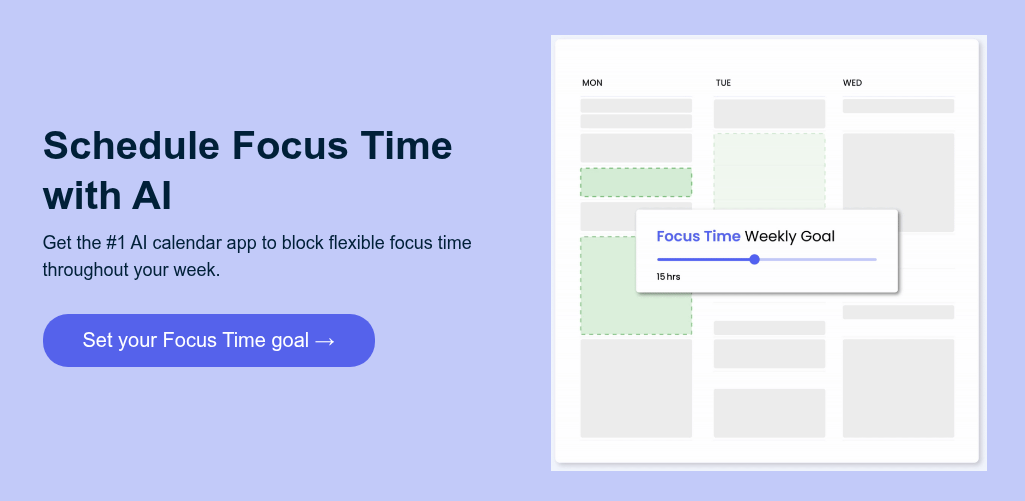
Reclaim: Set a weekly Focus Time goal, and automatically defend flexible time in your calendar around your existing events. Reclaim Focus Time offers advanced settings on scheduling modes and custom preferences.
2. Smart Meetings
Clockwise: Flexible Meetings auto-shift with meeting hours to create more Focus Time for attendees. While this reduces fragmentation, it doesn’t help teams prioritize meetings by importance, optimize their meeting load, or maximize their availability for external meetings.
Reclaim: Smart Meetings are AI-powered recurring meetings that automatically find the best time to meet across all calendars, flexibly scheduling by priority and auto-rescheduling for conflicts (like high-priority Scheduling Link meeting or PTO). It balances importance and regular collaboration intelligently so teams stay connected, while optimizing times to free up longer Focus Time sessions and reduce costly calendar fragmentation.
3. Tasks & Habits
Clockwise: Uses ‘Flexible Holds’ to block time for one-time tasks and recurring routines within a scheduling window you define (days and time-of-day) and automatically reschedules when conflicts pop up (once per day). But they lack prioritization intelligence, due-date-aware scheduling, and do not break down your large Tasks into multiple work sessions.
Reclaim: Reclaim Tasks automatically sync and block time for everything on your task list, by priority, before your due date, and across multiple work sessions. Reclaim Habits are intelligent recurring routines that automatically find the best time in your calendar. Both Tasks and Habits automatically reschedule instantly around conflicts, and track to your Focus Time goal.
4. Prioritized scheduling
Clockwise: Does not support priority levels or due-date–aware scheduling, just basic flexibility-based optimizations to preserve Focus Time within user-defined windows.
Reclaim: Allows you to set priority levels 1–4 on any AI-powered event or non-Reclaim event to automatically prioritize your time around your most important deadlines, maximize your availability for important meetings, and auto-reschedule events by priority.
5. Google Calendar & Outlook Calendar support
Clockwise: Available on Google Calendar, and Microsoft Outlook Calendar support is in beta. Clockwise previously launched Outlook Calendar, but pulled it back into beta and has since announced they are discontinuing development for Outlook.
Reclaim: Available on both Google Calendar and Microsoft Outlook Calendar.
6. Integrations
Clockwise: Integrates with Zoom and Slack, and offers a Chrome extension.
Reclaim: Integrates with Google Tasks, Jira, ClickUp, Todoist, Linear, Asana, as well as Slack, Zoom, Google Meet, Gmail, Webhooks, and offers a Google Calendar add-on.
7. Calendar Sync
Clockwise: Only supports Google Calendar for a basic one-way sync of your personal calendar to your work calendar (no bi-directional support), and only offers a short 2-4 week sync range, and far less granular controls on event-type filters and visibility settings.
Reclaim: Supports both Google Calendar and Outlook Calendar syncs across an unlimited number of calendars and bi-directionally sync. Reclaim also supports advanced privacy controls for how synced events appear to protect your personal details, and supports a 12-month sync range to defend long-term personal plans from work commitments.
8. Scheduling Links
Clockwise: Offers Scheduling Links that surface times based on your current calendar and preferences. You can allow all Focus Time to be bookable or keep it protected, but their links do not intelligently preserve Focus Time based on your availability or auto-reshuffle other events.
Reclaim: Offers AI-powered Scheduling Links that allow you to surface 524% more availability for new meetings because it understands which meetings and focus time blocks you’d be willing to auto-reschedule to book an important meeting sooner.
9. Pricing & free tier
Clockwise: Free covers basic individual automation (lunch/travel holds, flexible holds, personal calendar sync, Slack/Zoom) and unlimited Scheduling Links. Team features like Focus Time holds, Flexible Meetings, group/round-robin links, analytics, and a longer 4-week optimization/visibility window are on paid tiers.
Reclaim: Offers a robust free forever tier which includes 1 Calendar Sync, 1 Habits, 1 Scheduling Link, unlimited Task scheduling, unlimited Buffer Time, plus full integration with Slack, Zoom, Google Meet, and Google Tasks. Advanced and unlimited AI-powered features available for teams and enterprises on paid plans.
10. Enterprise support
Clockwise: Offers an Enterprise plan that supports SCIM provisioning, custom data processing, calendar exclusion list, and preferred support.
Reclaim: Offers an Enterprise plan that supports SSO and SCIM provisioning, delegated access, Focus Time OKRs, enterprise reports, company-wide Slack status templates, dedicated premium support, and domain capture for new signups and employees.
11. AI Scheduling Assistant
Clockwise: Open beta. “Clockwise Calendar” is a GPT-powered, conversational assistant. You can type or use voice/Slack DMs to schedule, reschedule, and adjust your day in natural language.
Reclaim: Beta opening December 2025. Allows you to use AI chat prompts to find time and schedule one-off meetings, resolve conflicts, optimize your day/week, and analyze where time goes.
Clockwise vs. Reclaim: What G2 users have to say
Clockwise: 4.7/5 stars on G2 (74 reviews)
✅ Positives:
- “Clockwise is the kind of tool I dreamt of as an Executive Assistant for many years. It makes it incredibly easy to schedule and reschedule meetings, find time to meet across busy calendars, and schedule meetings with external parties without the annoying back-and-forth of sending availability via email.“ (source)
- “Automatic booking of focus time blocks and automatic rearranging of meetings are the most valuable features to me. I like that it re-jigs my focus time automatically if I have to book something in the middle of a focusing block too. I like that it shows me how much focus time I'm taking away from people when I book them in a meeting!” (source)
🔴 Negatives:
- “I don't trust Clockwise to properly prioritize conflicts or to reschedule meetings for the right dates/times. Events aren't always linked to Clockwise--sometimes I have to manually tag Clockwise in. maybe because I don't refresh my calendar tab often enough?“ (source)
- “Deleting events from other coworkers off your calendar isn't the easiest or intuitive thing. Also, sometimes it duplicates calendar events, which again is a struggle to delete when first using Clockwise.“ (source)
Reclaim.ai (4.8/5 stars on G2) (121 reviews)
✅ Positives:
- “I've never been so happy about my calendars until I started using Reclaim. This app is a lifesaver. It allows me to sync my work and personal calendars as well as create routines out of the habit feature. I also like that it can "defend" my focus time at work yet still be able to adjust/ flex schedules. Integrates with Slack, ClickUp and Asana which are the major tools I use at work.“ (source)
- “Reclaim manages my 1:1s with a 10 person team requiring different check-in frequencies around a variable schedule, which I would not be able to manage without. It also defends my time so I am able to get my other work done. They recently brought in prioritization of all events, which has been a gamechanger for me. ” (source)
🔴 Negatives:
- “Some of the main features, such as integration with various calendars, are inevitably paid. The cost is not high, however, there are other similar free tools.” (source)
- “You have to log in to their website to manage many stuff and it creates one more thing to do.” (source)
Deep dive: Reclaim vs. Clockwise
1. Focus Time: generic vs. AI defense
On the surface, Clockwise and Reclaim both promise Focus Time. The difference is how resilient that Focus Time actually is once your calendar starts changing – which it inevitably does.
Clockwise creates generic Focus Time blocks that are either marked as free or busy. This works well enough if you can reliably protect large, uninterrupted chunks of time and don’t need to rebalance meetings often. But when priorities change, Focus Time tends to either get overridden entirely or become too rigid to work around.
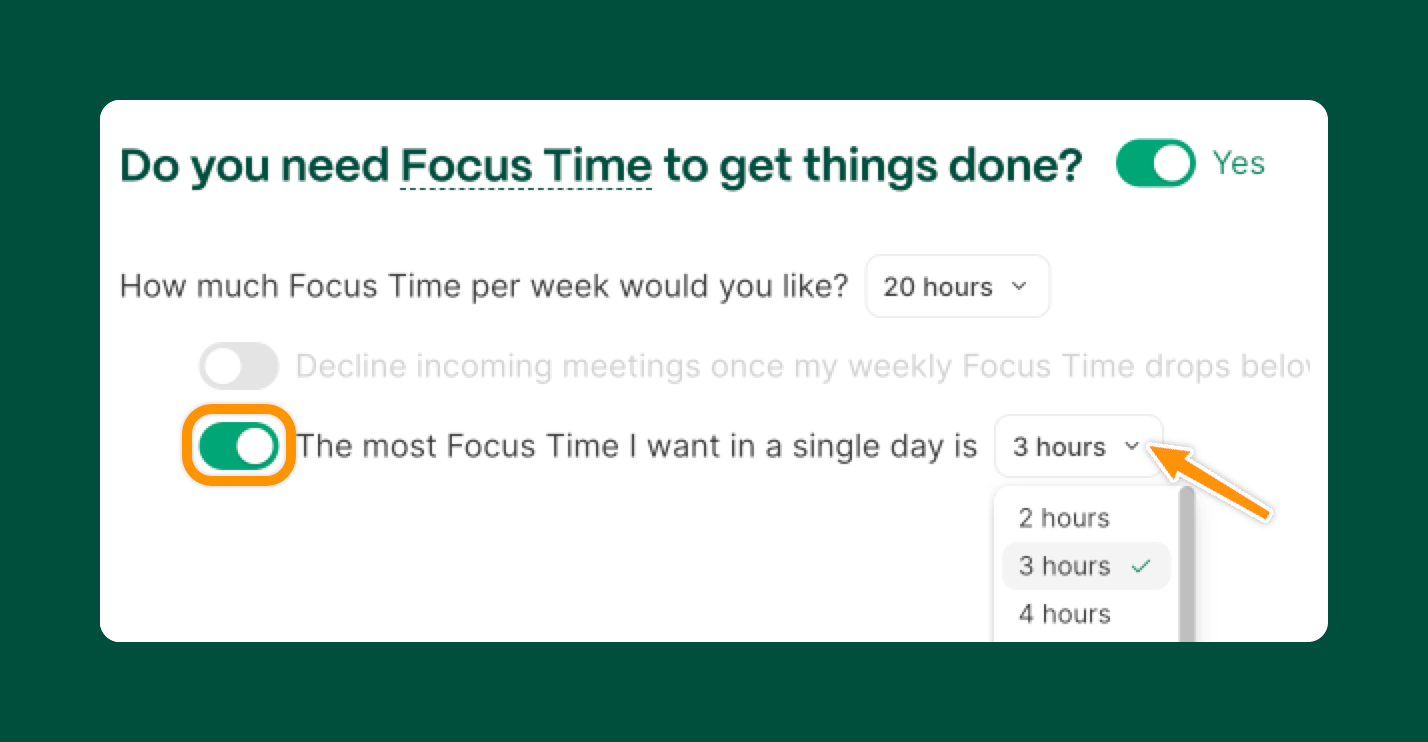
They also only allow you to set a max amount of Focus Time per day and preference for mornings or afternoons – no ideal durations, min or max duration per session, or custom hours for scheduling.
Reclaim treats Focus Time as a dynamic goal rather than a fixed block. You define how much Focus Time you want each week, and Reclaim continuously re-optimizes your calendar to defend it. Focus Time flexes around meetings, tasks, habits, and deadlines – automatically adjusting as new conflicts appear. And Reclaim provides benchmark Focus Time targets for individuals based on their role and department so you know how much other professionals in your space need.
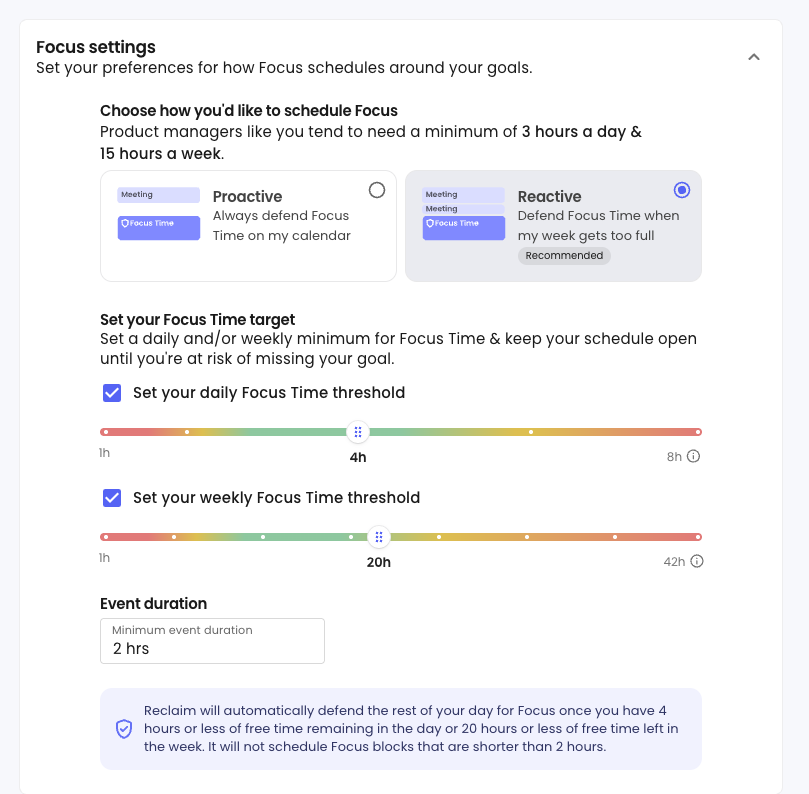
Reclaim also offers advanced Focus Time scheduling modes – proactive scheduling to automatically defend time, and reactive scheduling to only defend time when your calendar gets too full. Additionally, you can set ideal and max duration per day, min and max Focus Time event durations (min is crucial for ensuring deep work), and create custom hours for exactly when you want to schedule heads-down work.
For people with meeting-heavy calendars, this difference is critical: Reclaim preserves deep work without forcing you to choose between being unavailable and being interrupted all day.
2. Smart Meetings: prioritization in practice
Clockwise and Reclaim both allow meetings to move automatically. The difference is what guides those moves once calendars become crowded.
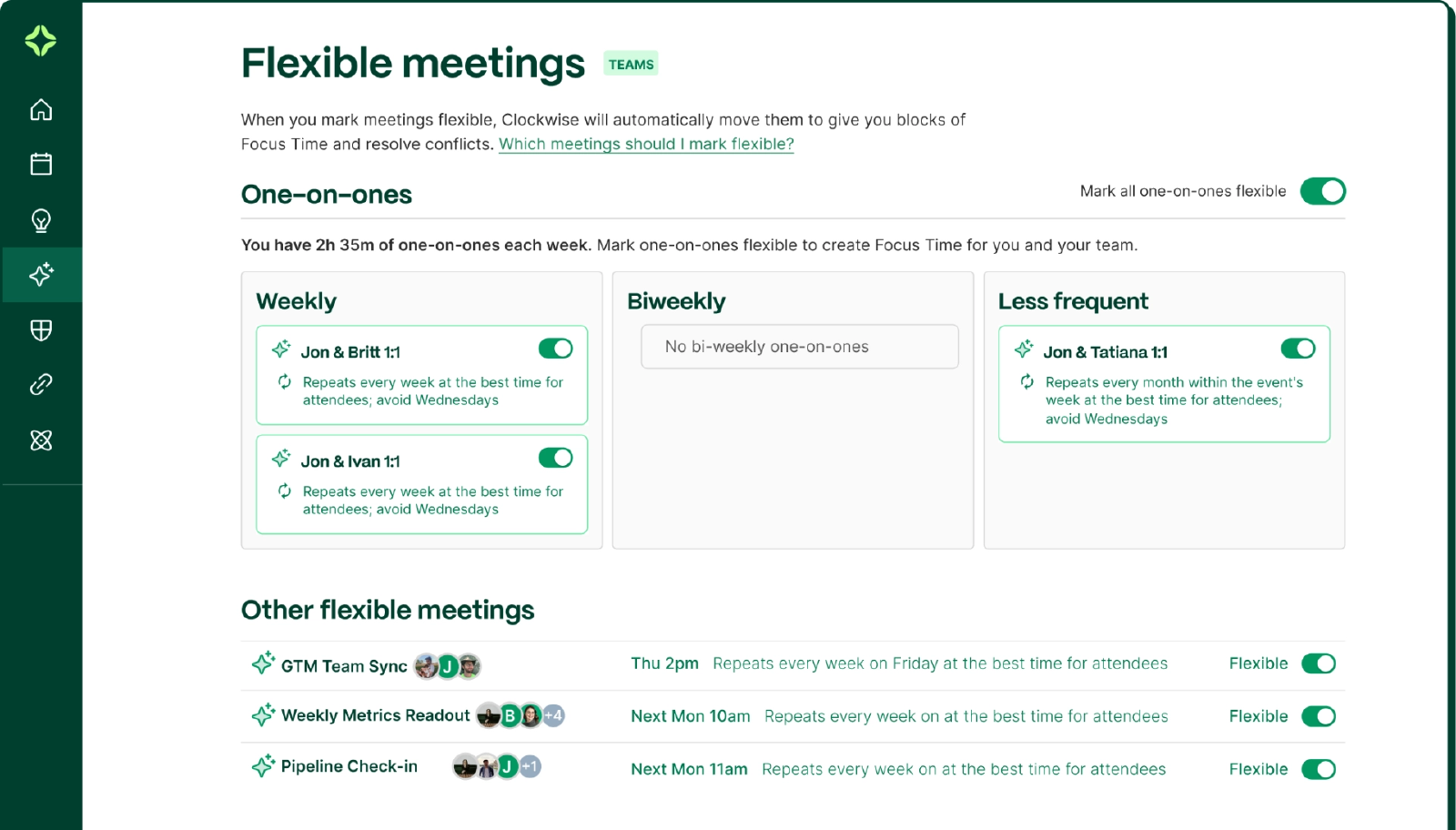
Clockwise’s Flexible Meetings are designed to reduce disruption. When conflicts arise, Clockwise calculates the total Focus Time cost across attendees and reschedules meetings to the least disruptive available time within defined meeting hours and flexibility settings. This helps preserve uninterrupted blocks of focus and reduce context switching across the organization.
But Flexible Meetings can only operate within preset time windows and apply the same disruption-minimizing logic to all flexible events. They don’t differentiate between higher and lower-priority meetings, evaluate task workload, or account for shifting business priorities when determining what should move first.
As meeting volumes or team sizes increase, Flexible Meetings effectiveness breaks down as it can’t help employees prioritize which meetings are a good use of their time, or actively bring their meeting load under control.
Reclaim takes a different approach. AI-powered Smart Meetings are built around prioritization and personalization. Each employee can define exactly how meetings can schedule across flexible time windows, including ideal days, preferred times, and custom hours — so meetings align with how you and your team actually work, not just default time windows. But personalization is only part of it.
Priority levels allow meetings to be evaluated in context against everything else competing for time on the calendar. Instead of optimizing purely for reduced disruption or focus time cost, Smart Meetings also account for relative importance across other meetings, Tasks, Habits, and existing events to guide scheduling decisions.
This means scheduling reflects real tradeoffs. Higher-impact commitments are protected first, while lower-priority meetings flex when necessary.
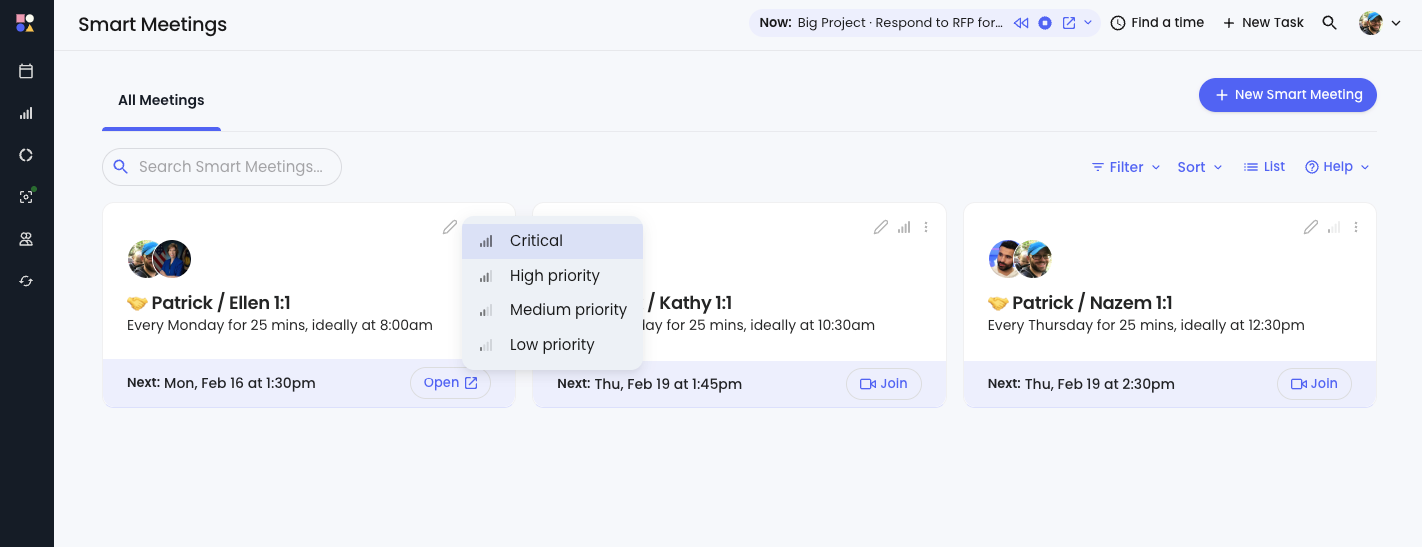
This allows Reclaim to optimize meetings both company-wide, and individually for each employee at the company:
- Important meetings are protected first
- Lower-priority meetings don’t crowd out critical work
- Meeting load stays aligned with real priorities
- Calendars adapt as priorities shift
- Individuals retain control over how their time is structured
Instead of simply moving meetings to minimize disruption, Reclaim helps teams decide which meetings deserve time in the first place – and keeps schedules aligned with what matters most.
3. Tasks & habits: placeholders vs. intelligent planning
Clockwise’s Flexible Holds can reserve time for tasks and routines, but they behave more like calendar placeholders than true planning tools. They reschedule when conflicts occur, but only once per day and without understanding urgency or importance. What’s missing is context – deadlines, priority, and scope.
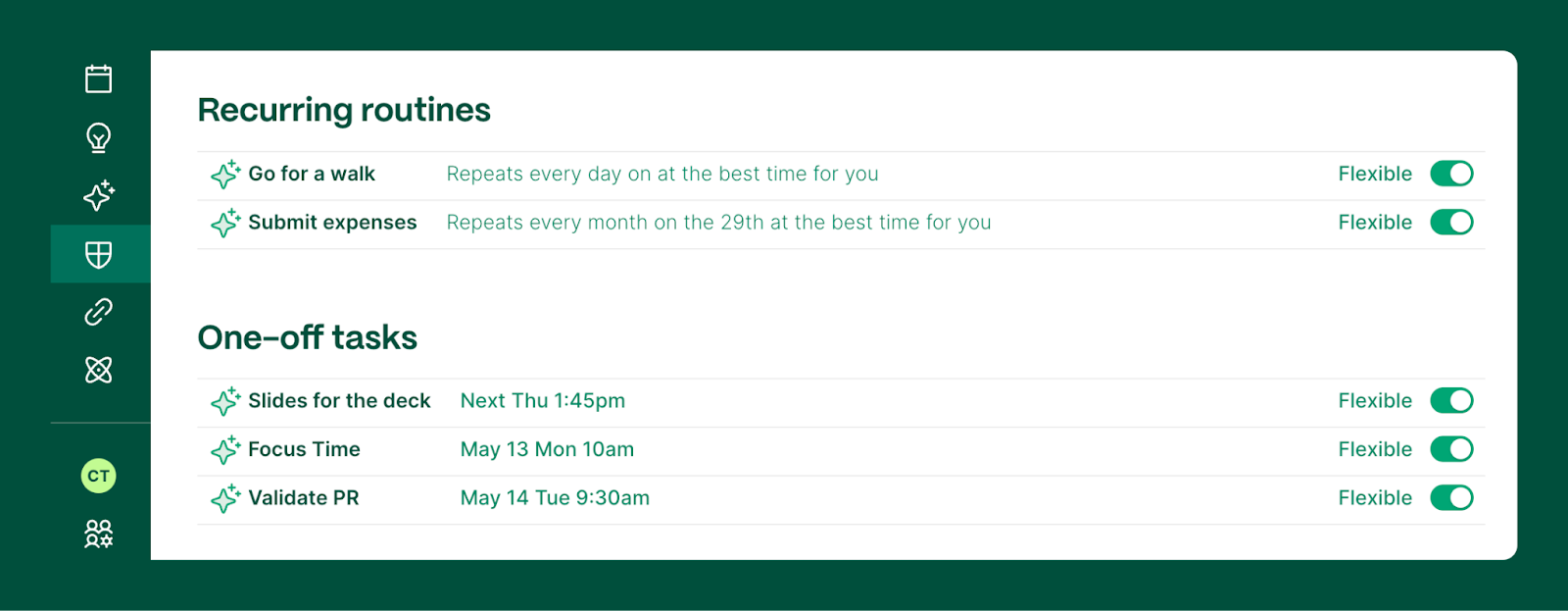
Reclaim offers AI-powered time blocking for one-time Tasks and recurring routines called Habits – filling that Clockwise context gap by treating Tasks and Habits as intelligent inputs to your calendar:
- Tasks are scheduled by priority and due date
- You can sync your Task list so your schedule is always up-to-date with your projects
- Large tasks are split into realistic work sessions
- Everything reschedules instantly as conflicts arise
- Task and Habit time rolls up into your Focus Time goal
- And you can explore 100+ Habit templates by role and department
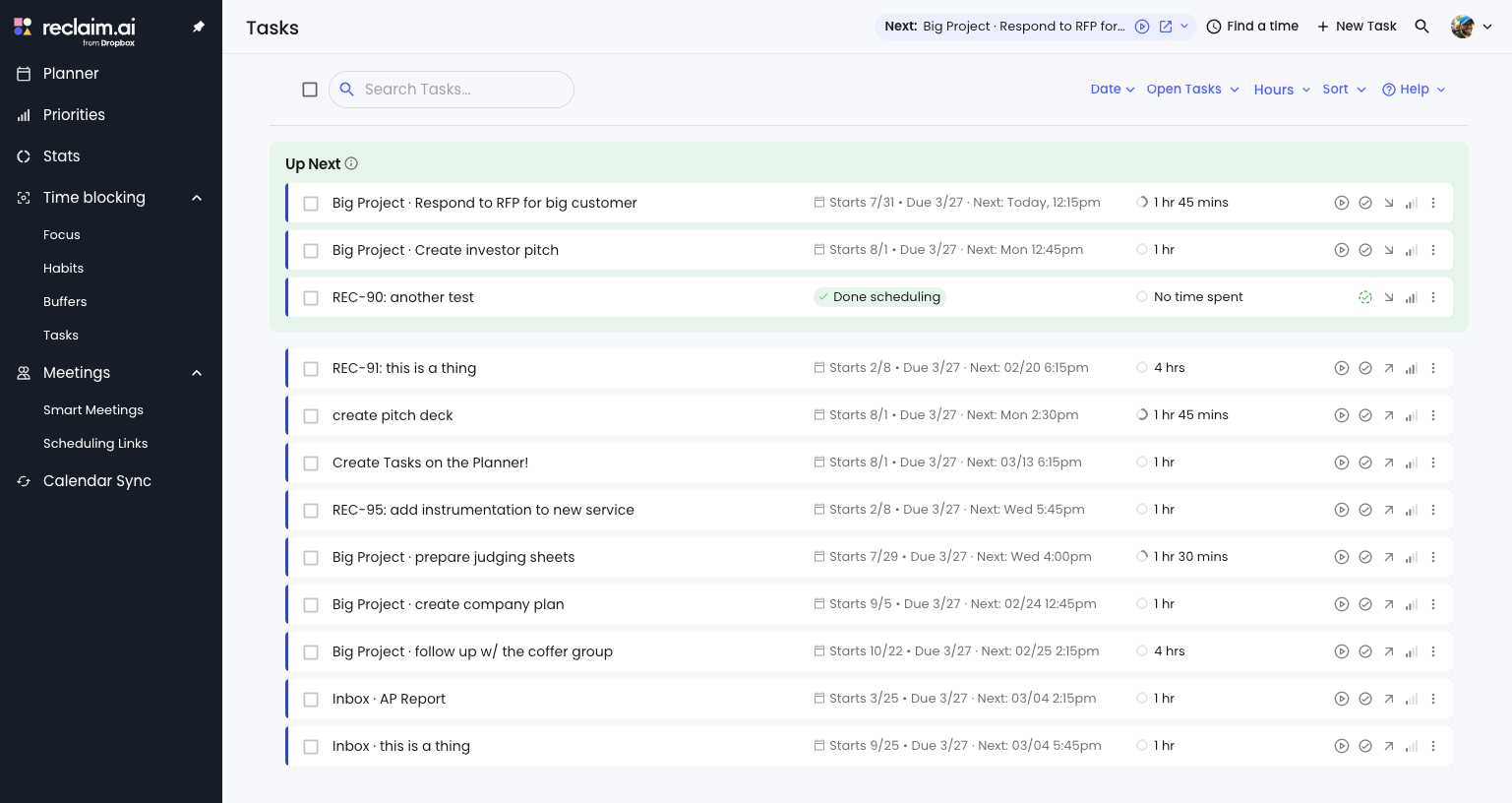
Instead of manually juggling to-do lists and calendar blocks, Reclaim turns your calendar into a living plan for getting real work done.
4. Prioritized scheduling: where the philosophies truly diverge
Clockwise optimizes within time windows, but it doesn’t understand what matters more when conflicts arise. All flexible time is treated roughly the same.
Reclaim is built around explicit prioritization. You can assign priority levels (1–4) to:
- Tasks
- Habits
- Smart Meetings
- Scheduling Links
- Even non-Reclaim calendar events
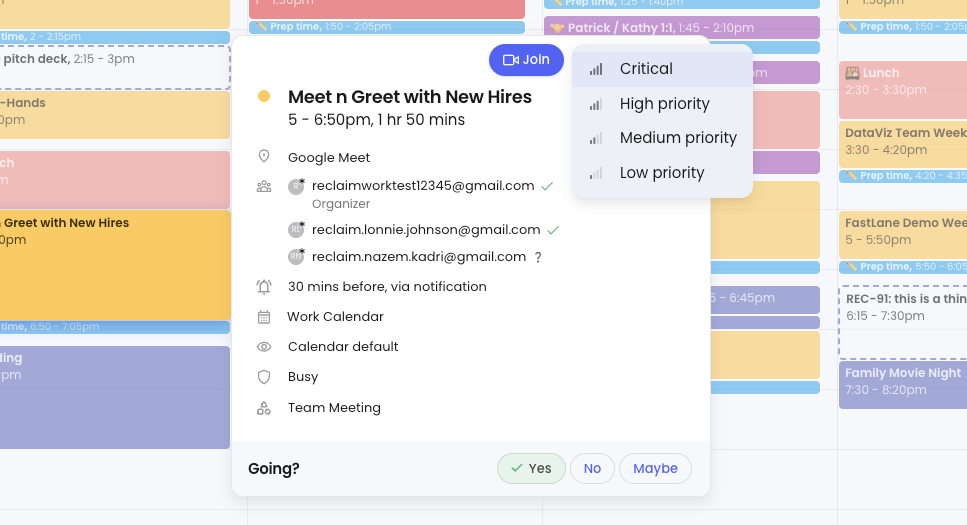
When something new gets scheduled, Reclaim automatically reshuffles lower-priority work to protect higher-priority commitments. This allows your calendar to reflect real-world tradeoffs, not just availability.
For teams, this means fewer fire drills, faster booking of important meetings, and less accidental crowding of critical work.
5. Calendar platform support: Built for real organizations
Clockwise was designed first for Google Calendar. Outlook support has remained limited, with Clockwise publicly sharing that Google Calendar is their primary development focus and that Outlook investment is being deprioritized. For Outlook-first or mixed-calendar teams, this can create long-term adoption risk.
Reclaim fully supports both Google Calendar and Microsoft Outlook, with feature parity across platforms.
For organizations with mixed environments – or anyone using Outlook day-to-day this alone often makes Reclaim the more practical long-term choice.
6. Integrations: connecting the calendar to actual work
Clockwise integrates with Slack, Zoom, and offers a Chrome extension – useful, but focused mostly on meeting coordination. They previously integrated with Asana, but discontinued that integration, which signals they are very unlikely to continue developments in task or project management integrations in the future.
Reclaim integrates directly with the tools teams already use to plan and execute work:
- Project management apps Jira, Asana, Linear, ClickUp, Todoist, and Google Tasks
- Communication and meetings via Slack, Zoom, Google Meet, and Gmail
- Advanced workflows via webhooks and a Google Calendar add-on
This allows scheduling decisions to reflect real workload, not just calendar availability.
7. Calendar sync: personal time that stays protected
Clockwise supports a limited, one-way sync from personal Google Calendars to work with a short 2-4 week lookahead window and fewer customization options. Their synced events can inform availability, but they cannot be reshuffled or protected. And any changes made on your work calendar do not flow back, essentially acting more like a read-only overlay on your calendar.
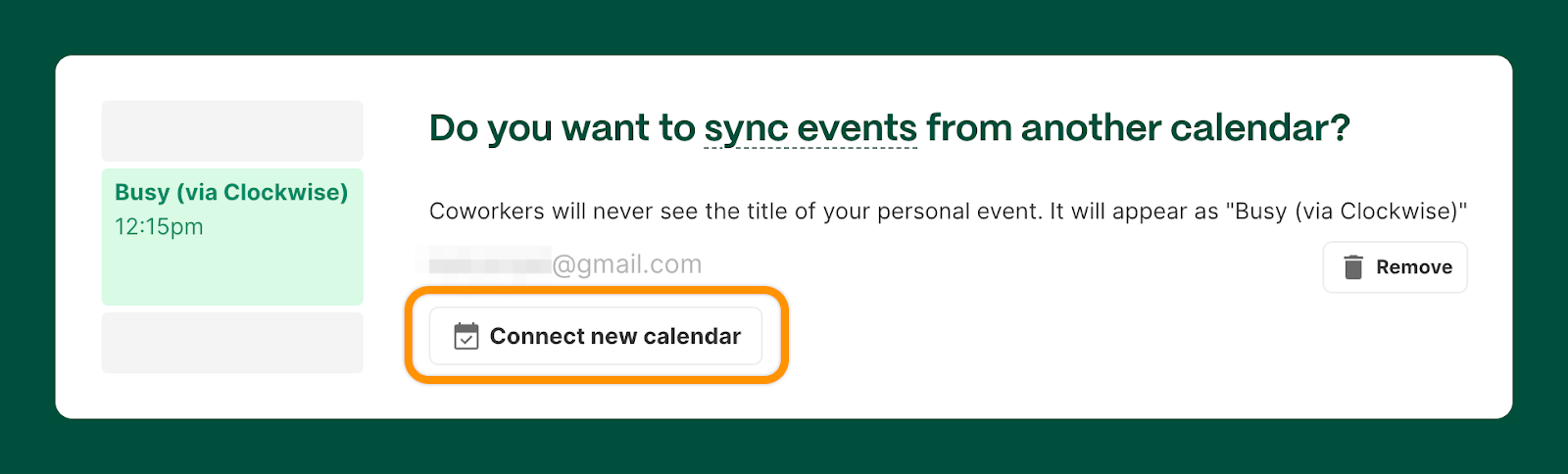
Reclaim supports advanced sync across Google Calendar and Outlook Calendars, with:
- Unlimited calendar syncs
- Bi-directional sync
- Up to 12 months of visibility
- Granular privacy controls for event visibility
- Custom settings for syncing all-day events
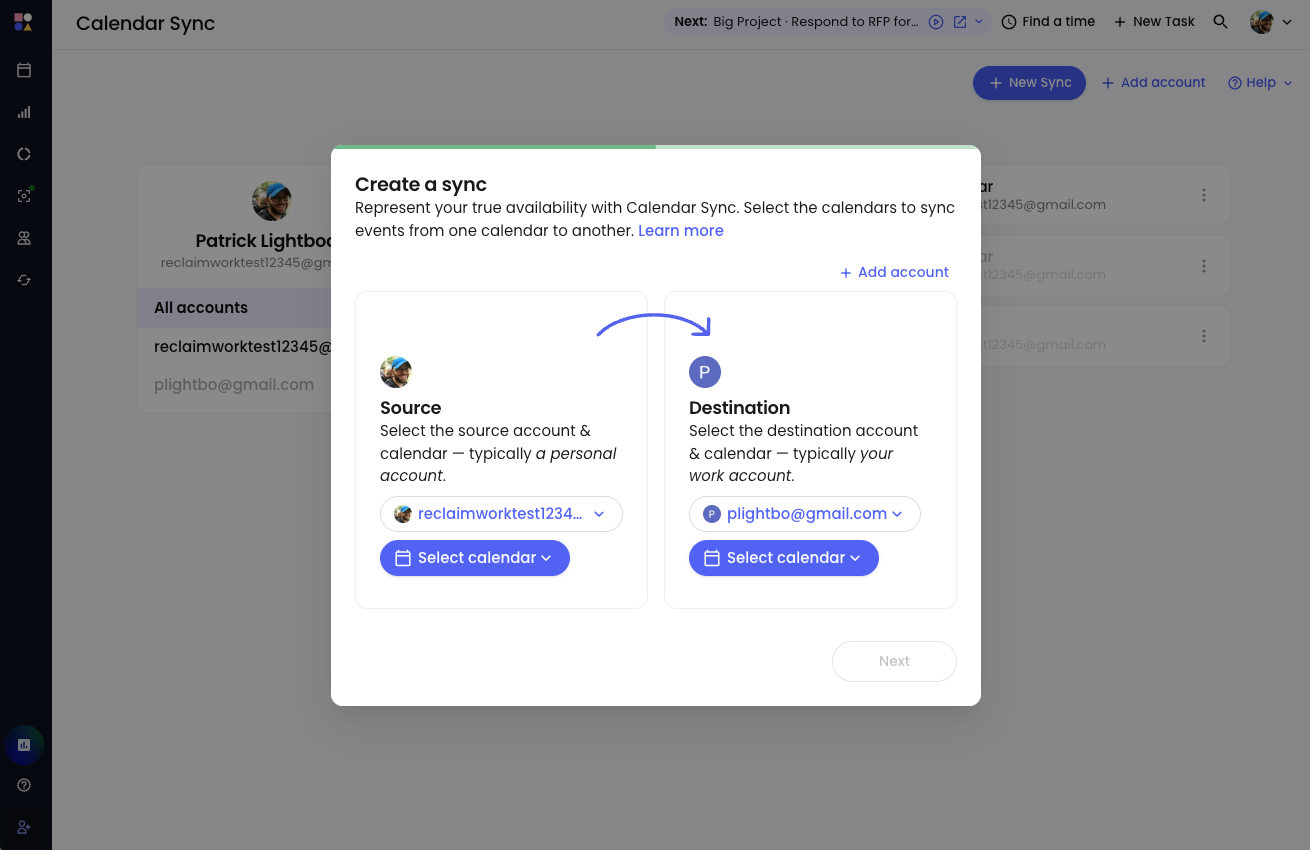
That means long-term personal plans don’t quietly get overwritten by work meetings when you use Reclaim even months in advance. But most importantly, you get to control how synced events appear to your coworkers, as Work Commitment, Personal Commitment, Busy, or full event details to all. This gives your team context around your schedule so they’re less likely to overschedule your commitments. Reclaim is also able to support work-to-work calendar sync, which is critical for consulting teams managing multiple client calendars, and M&A scenarios with organizations managing multiple emails and calendars after an acquisition.
8. Scheduling links: availability that leverages AI
Clockwise Scheduling Links primarily surface open availability based on your current calendar state. You have to choose whether Focus Time is fully bookable or completely protected – their Scheduling Links don’t use priority levels to let you surface more availability for urgent meetings vs. low-priority meetings. When someone books time:
- Existing meetings and Flexible Holds generally remain fixed
- Focus Time is either sacrificed or untouched with little nuance
- There’s limited ability to reshuffle other work to make room for something important
This works well when your calendar is already fairly open. But for meeting-heavy calendars, it often leads to one of two outcomes:
- You expose too much Focus Time just to create availability, or
- You appear “unavailable” even when tradeoffs would be acceptable
Reclaim’s Scheduling Links are priority-aware and allow you to offer 524% more availability because they know which internal meetings or focus time blocks you’d be willing to auto-reschedule to get an important meeting booked sooner. You can even lower the priority level of a non-Reclaim event to create even more open time slots for schedulers.
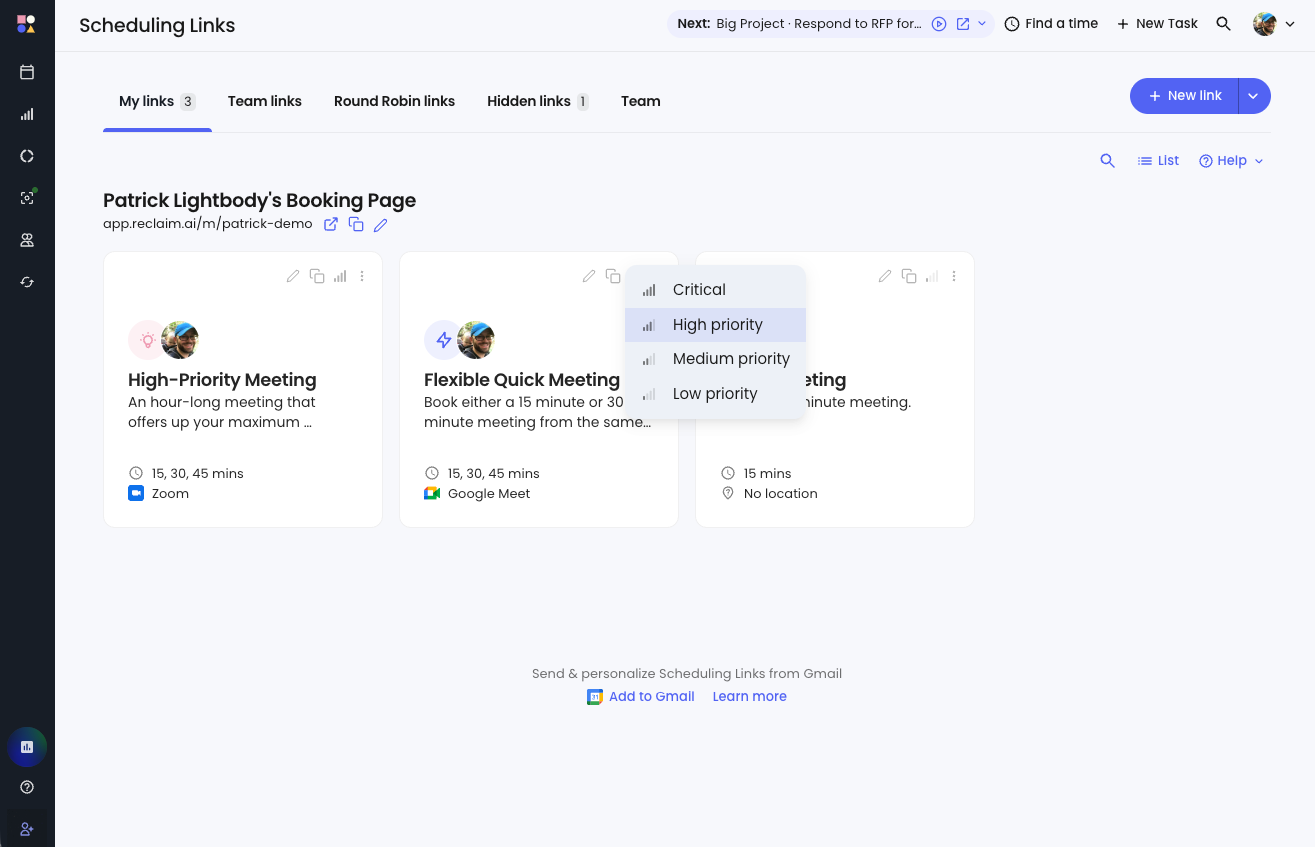
This is critical for sales teams who need to move fast on deals, HR teams looking to secure top talent before candidates are off market, and teams working with external partners they need to stay in sync with.
9. Pricing & free tier: value without friction
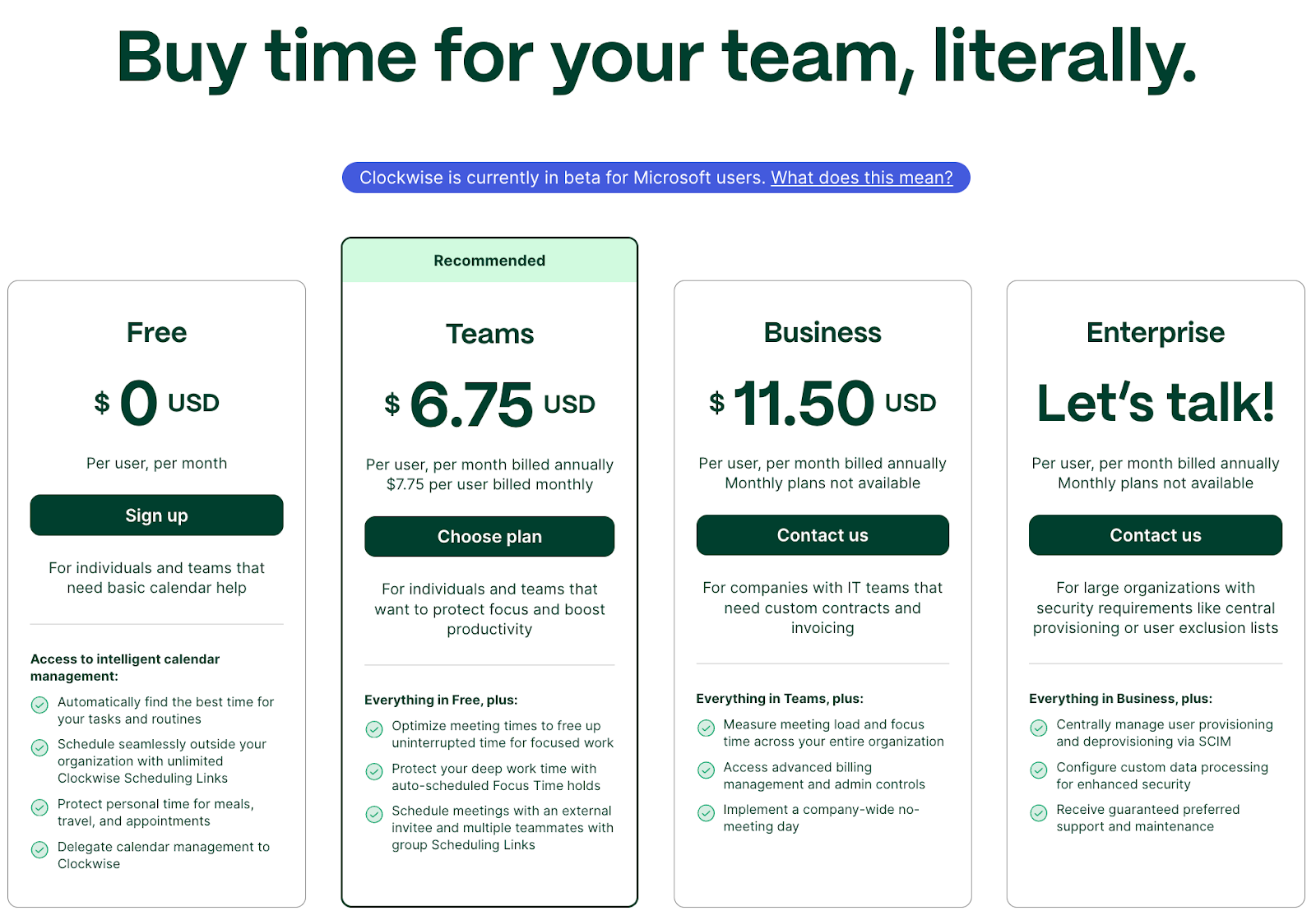
Clockwise’s free plan includes helpful basics like lunch holds, travel buffers, personal calendar sync, and Scheduling Links. For individual users with relatively simple calendars, this can be enough to get started. However, many of Clockwise’s most valuable features are reserved for paid plans. Their pricing starts at $6.75/month.
Reclaim offers a robust free-forever plan that includes:
- Unlimited task scheduling
- Unlimited Buffer Time
- One Habit
- One AI-powered Scheduling Link
- Two Connected Calendars
- Universal Priorities
- No-Meeting Days
- Smart Color-Coding
- Weekly Productivity Reports
- Core integrations
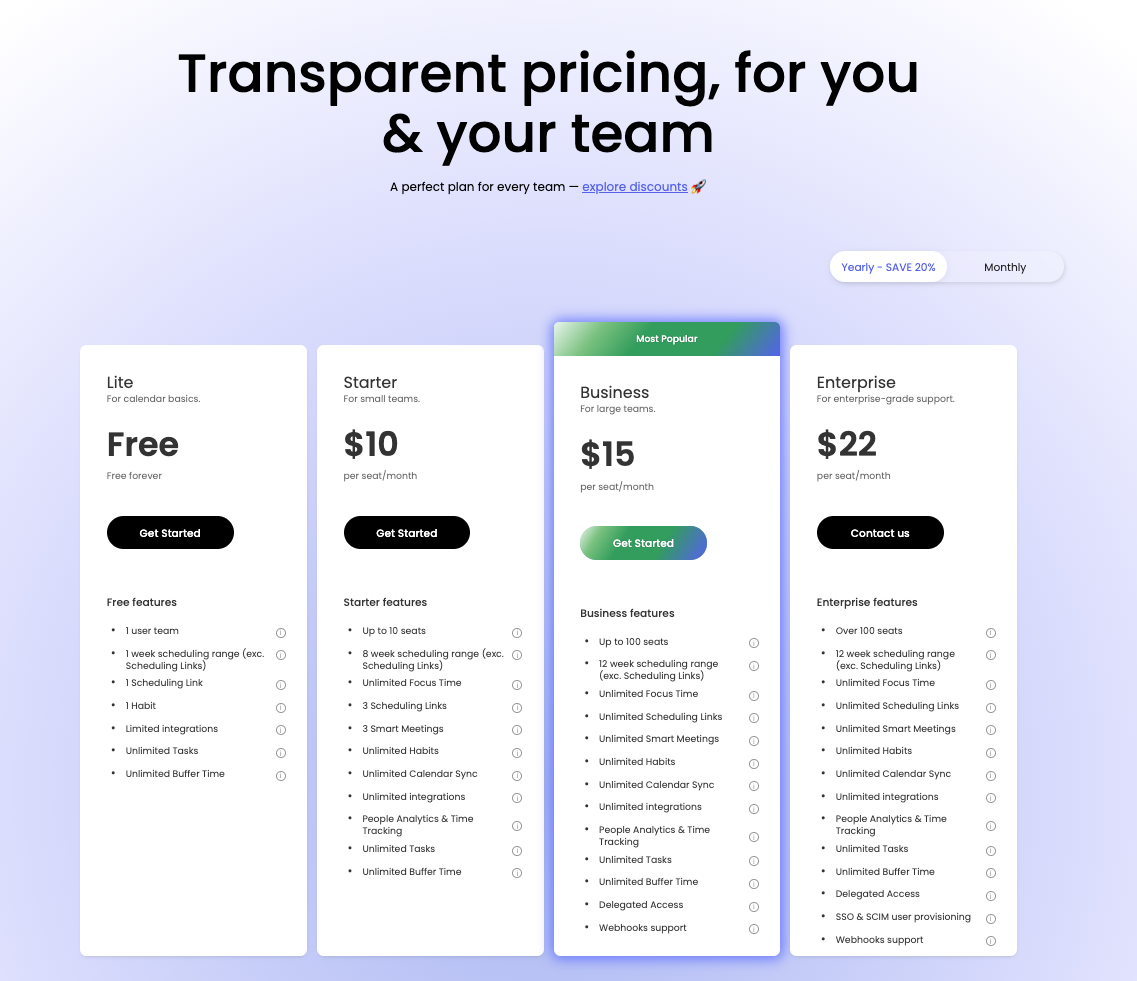
This makes it easy to experience meaningful automation before upgrading – and avoids forcing teams to pay just to stay organized. Reclaim’s powerful paid plans start at $10/month.
10. Enterprise readiness: designed to scale
Clockwise’s Enterprise offering is focused primarily on account-level management and access control. It includes features like SCIM provisioning, data processing agreements, calendar exclusion lists, and preferred support. These capabilities help IT teams manage users and permissions, but they stop short of shaping how time is actually used across the organization.
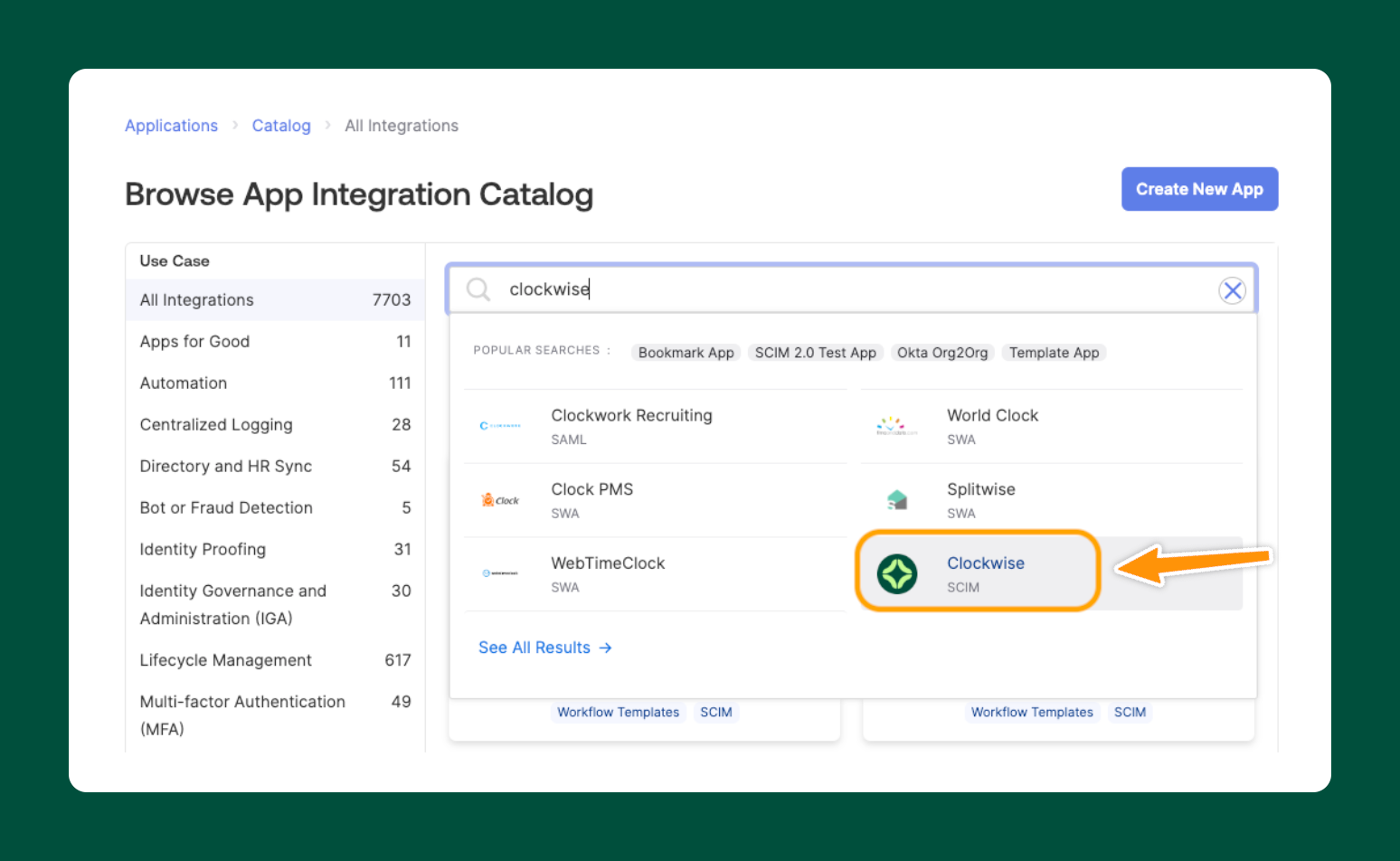
Clockwise’s enterprise features largely preserve an individual-first experience: teams can adopt the tool, but there are limited mechanisms for setting company-wide scheduling standards, measuring Focus Time outcomes, or driving consistent behavior across roles and departments.
Reclaim’s Enterprise offering is designed for organization-wide scheduling strategy, not just user management. In addition to SSO and SCIM provisioning, Reclaim supports delegated access (such as exec admins managing leader calendars), domain capture to automatically onboard new employees, and centralized defaults that encourage consistent scheduling behavior without micromanagement.
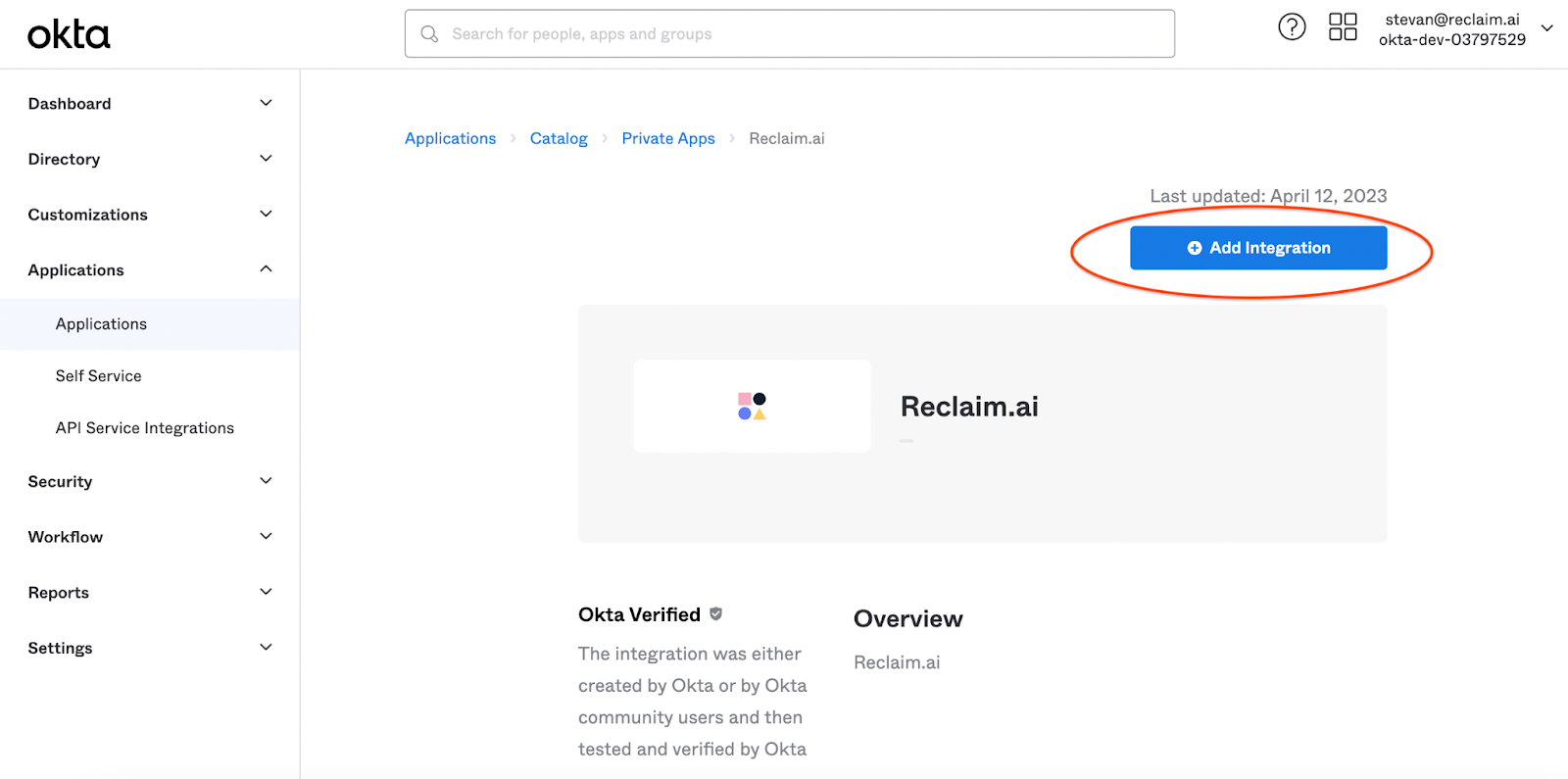
Reclaim also introduces Focus Time OKRs and enterprise reporting, allowing organizations to set shared Focus Time goals, track progress over time, and understand how meetings and tasks impact deep work across teams. Company-wide Slack status templates and advanced analytics help reinforce best practices while maintaining individual flexibility.
For enterprises that want more than basic access controls – and instead want visibility, consistency, and measurable improvements in how time is protected, Reclaim offers deeper control and long-term value at scale.
11. AI scheduling assistants: the next evolution
Clockwise offers a GPT-powered conversational assistant that’s in beta for basic scheduling actions, but there’s no public user feedback, testimonials, or case studies that highlight its performance or quality.
Reclaim’s AI Scheduling Assistant (beta opening December 2025) is designed to help users go beyond booking:
- Quickly find time for meetings across multiple busy calendars
- Resolve conflicts intelligently
- Optimize days and weeks holistically
- Analyze how time is actually spent
- Make proactive recommendations based on priorities
- Assist organizational leaders in decision-making and initiative planning.
Bottom line – which AI calendar should you choose?
Clockwise is a strong choice for individuals with very light calendars who mainly want to protect blocks of Focus Time.
Reclaim is built for the complexity of modern work where priorities shift, meetings pile up, and calendars need to adapt continuously. If you want an AI calendar that actively manages tradeoffs not just blocks time, Reclaim is the more powerful, future-proof solution.
But ultimately, it comes down to what fits you and your team’s workflow best. Try them both and decide for yourself! If you’re looking to switch from Clockwise to try out Reclaim – check out the switching providers discount to get 20% off for 6 months.
Productivity Trends Reports